

 English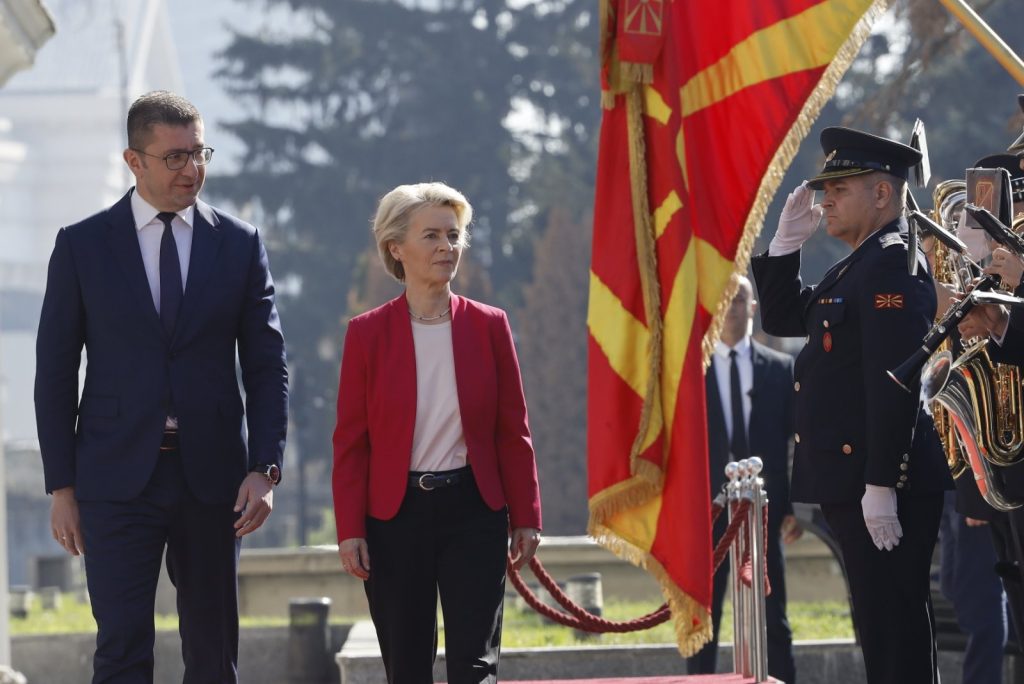
European Commission President Ursula von der Leyen will arrive to Skopje on Friday as part of her tour of the Western Balkans.
According to her office, von der Leyen will hold meetings with President Gordana Siljanovska-Davkova and Prime Minister Hristijan Mickoski. Discussions will focus on the European prospects of Macedonia and the region, as well as the EU accession process. The issue regarding Bulgaria and potential ways to resolve it are also expected to be addressed.
Ahead of von der Leyen’s visit, Foreign Minister Timcho Mucunski stated that Macedonia seeks a solution with Bulgaria that would ensure predictability in the European integration process. He noted a willingness among European institutions and certain EU member states to help strengthen mutual engagement and open avenues for discussion; however, he emphasized that the country’s position remains absolutely clear: under current circumstances, there are no conditions for constitutional amendments, given Bulgaria’s stance.
Although bilateral contacts with Sofia have taken place, they have not yet yielded progress; consequently, according to Mucunski, assistance is needed from the interested party—the EU. Therefore, he views the upcoming visit to Skopje by European Commission President Ursula von der Leyen—during which this topic will be discussed in greater detail, among other things—in a positive light. There is no doubt in our country that a solution is needed, the minister says, but we are drawing a red line: the solution found must ensure predictability and security.
The EC President will begin her tour of the Western Balkans on September 30 in Albania, followed by visits to Kosovo and Montenegro. This time, Serbia and Bosnia and Herzegovina will not be part of her itinerary. European Commission spokesperson Arianna Podesta announced that the two countries were excluded because they are preparing for elections. Serbia is set to hold early parliamentary elections on October 25, while general elections in Bosnia and Herzegovina are scheduled for October 4. The visit follows reports that the EU wants to create some form of EU accession that will not be blocked by vetoes from individual member states, but apply it only to Ukraine, Moldova, Montenegro and Albania.