


 English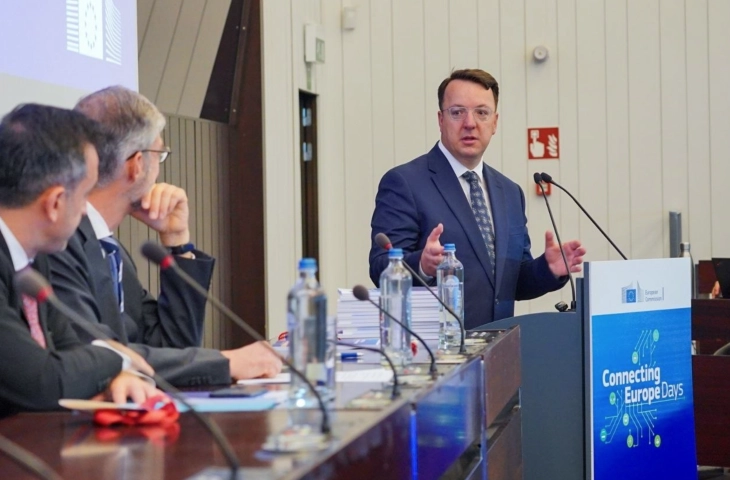
As a landlocked country in the Balkans, we are implementing massive investments in the development and modernization of the two European corridors—8 and 10—that pass through Macedonia. We are working on the construction of highways along Corridor 8 and are also building a railway line on the eastern section of this corridor. In parallel, we have begun constructing a high-speed rail line on Corridor 10 and are working on implementing ITS systems for the road network. We are also collaborating with our neighbors to expand border crossings, stated Deputy Prime Minister Aleksandar Nikoloski while addressing the “Connecting Europe Days” global event in Brussels.
During the panel dedicated to the Western Balkans–Eastern Mediterranean region, Deputy Prime Minister Nikoloski highlighted the political and economic significance of these corridors and the investments being realized in Macedonia.
Regarding the eastern section of Corridor 8, we are investing in both highways and railways. We have completed the first phase of the highway project, and we expect work on the second phase to begin next year in partnership with the European Union and the European Investment Bank—acting as the lead financial institution—and I would like to express my gratitude for this excellent cooperation. As for the railway, it comprises three sections: we have completed the first section, while the second is currently under construction and is scheduled for completion by the end of 2028. Last week, again in cooperation with the EIB, we launched the procurement process to select a contractor for the construction of the third section—the most challenging phase of the railway corridor. Although it spans only 23.1 kilometers, 75% of the route consists of engineering structures—comprising over 20 tunnels and 56 bridges—which illustrates the project’s complexity. The route passes behind a border town and connects to the joint tunnel we are to build together with Bulgaria. This represents one of the few pieces of positive news regarding our relations with Bulgaria at the moment; last November, we signed a joint intergovernmental agreement to construct this cross-border tunnel, which is intended to open up the entire Corridor 8. If everything proceeds according to plan, within five years of selecting the contractor—by 2031–2032—we should have a complete railway connection linking Skopje, Sofia, Burgas, Varna, and Odesa, Nikoloski noted.
He explained that, on the western side, they are working with the EU and partners on the reconstruction of the existing railway and the construction of the section connecting us to Albania.