
 English
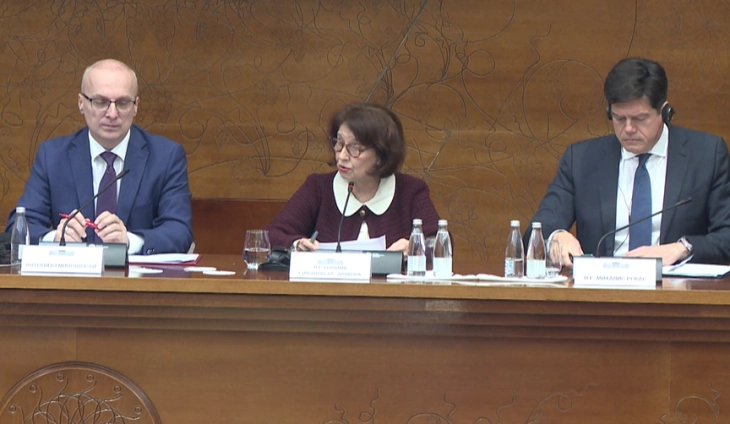
Insufficient predictability of the further accession process and of our path toward the EU, an insufficiently clear boundary between the membership criteria and bilateral political issues, and the absence of sufficient institutional guarantees that the fulfillment of the agreed conditions will enable real progress in the negotiations and in the process itself – these are the four dimensions important for the progress of the state toward the EU, which President Gordana Siljanovska-Davkova highlighted in her address at the joint session of the Committee on European Affairs and the National Council for European Integration, at which the EC report on Macedonia for 2026 is being debated.
Nothing so far has shaken us from remaining on the European path and nothing will shake us. Our goal remains the same – full membership in the European Union. We are not asking for privileges, we are not asking for special treatment, we are not asking for lower standards. We are asking for consistent application of European rules, principles and values, equality, legal certainty and accession based on merits, the President said.
According to her, we must all do something together, both we, our neighbors and our European partners, in order to get out of the labyrinth.
Anyone who claims that it is only about constitutional amendments, I believe is not being sincere. Either they have an intention or they have no desire to understand the background of our concern. In this sense I want to point out that my message to all our neighbors is that good-neighborly relations must be a bridge toward the EU, and not an instrument for the indefinite postponement of the European perspective of the neighbor. In good will, with mutual respect and reciprocity, to use the language of the basic constitutive acts of the European Union, let us hear each other, let us try to understand each other and when we do not agree, let us not shout over each other because from the high tones the smart and the wise will not be heard. There are such people on both sides of the border, among all the neighbors; let us give them space to express themselves, Siljanovska-Davkova emphasized.
She pointed out that from the EU we expect that “as an objective broker it will make clearly known through strict rules that bilateral issues that are not related to the accession criteria should not be part of the negotiations and that this principle must have real institutional application, and not remain only as a declaration, both for the others and for us.”
Regarding the report itself, Siljanovska-Davkova stated, it is good that no backsliding has been noted.
We can say that it is also good that the alignment of Chapter 10 – digital transformation and media and of Chapter 26 – education and culture is at a higher level. There is good progress in Chapter 10 – digital transformation and media, science and research and 31 – foreign, security and defense policy, the most important for the world, for the EU, for Europe and for us. Particularly important is the high level of alignment in the chapter on common security and foreign policy, I emphasize, something that is now a horizontal condition for advancing in the process. However, the fact is that this pace of noted progress is not sufficient to maintain the long-held high place of alignment with EU law compared to the other countries in the region, the President said.