
 English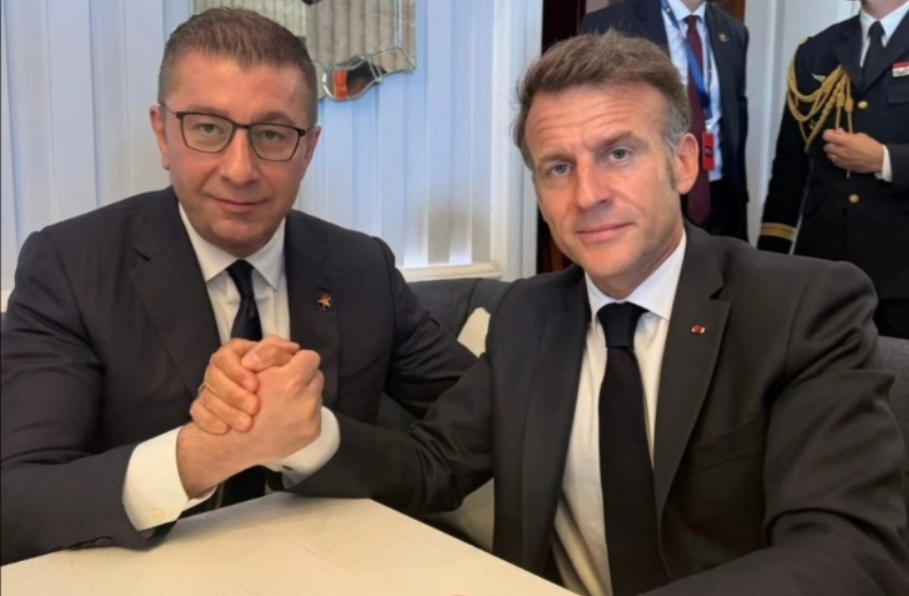
The Macedonian Government is in communication with European leaders and senior representatives of the European Union to find a solution that would unblock the Macedonian EU integration process, but the key question is what is being discussed and what the country is prepared, said Prime Minister Hristijan Mickoski in a TV interview today. Mickoski said that the talks are on-going, that they have never been a secret and that they will continue, but that the Government does not intend to make hasty decisions just to move the process forward.
Mickoski confirmed that the issue of unblocking the European path is one of the main topics in his talks with European statesmen.
There is no doubt that we will talk, are talking and have talked in order to seek a solution. The question is what you are talking about and what is your red line that you are going to in those talks. That is our task both before the citizens who have given us their trust, and also as a Government, said the Prime Minister.
As an example, he pointed to the meetings in Tivat with French President Emmanuel Macron and German Chancellor Friedrich Merz, stating that one of the central topics was precisely the possibility of advancing Macedonia’s European integration. According to Mickoski, the talks do not necessarily mean formal negotiations at one table, but take place within the framework of bilateral meetings and direct contacts with European partners.
We have talked, are talking and will continue to talk. Another question is whether we will manage to reach a solution in those talks, considering what our position is, said the Prime Minister.
He again sharply criticized the position that the current Government inherited from the previous Government, assessing it as “treacherous and defeatist”.
We started from that position and we try step by step to restore what can be restored, said Mickoski.
Asked whether there is a mediator or facilitator in the talks, the Prime Minister said that communication is mainly conducted with presidents and prime ministers of European countries, as well as with senior EU representatives. He revealed that there is also direct contact between his cabinet and the cabinets of Merz and Macron. Mickoski pointed out that European integration was a central topic in the talks with the President of the European Council Antonio Costa and the European Commissioner for Enlargement.
There are no secrets here under or over the radar. That is the essence of this government, in addition to taking care to solve domestic problems and domestic challenges, to also manage to solve international, i.e. external challenges, he said.
The Prime Minister, however, warned that the international situation is becoming increasingly complex and that it is not certain how long EU enlargement will remain among the priorities of the largest European countries. According to his assessment, the increased interest in enlargement is currently largely related to Ukraine, and in that context the Western Balkans are also included. However, domestic political processes in key European countries, Mickoski believes, can change the focus. He pointed to the political developments in Germany and the growth of the AfD’s rating, as well as the upcoming elections in France. According to him, possible political restructuring in these countries can also affect their attitude towards further enlargement of the Union.
According to the Prime Minister, additional uncertainty is also created by global geopolitical and economic challenges, including the conflict in Iran and the rise in oil prices.
Speaking about the possibility of Macedonia being part of the same wave of enlargement with Montenegro and Albania, Mickoski revisited the promises from the period of the Prespa Agreement and the change of the constitutional name. He recalled that in 2018, when VMRO-DPMNE was in opposition, some European diplomats assured that resolving the dispute with Greece would put the country on the “fast track” towards the EU.
They convinced us that the window was open, that now was the moment, that we were frontrunners in the region and that if we accept and digest this pledge, we would immediately become a NATO member state and within four to five years we would complete the negotiations and become an EU member state. Those four to five years passed two to three years ago. We are in the same place where we were 21 years ago, said Mickoski, adding that “that is why the Government has no room for improvisations and decisions made under pressure”. According to him, every next step should be carefully analyzed before accepting a solution that would have long-term consequences for the country.
In parallel with the political talks on unblocking the European integrations, Mickoski believes that Macedonia should try to strengthen its position through faster mplementation of the reforms from the Reform Agenda. Mickoski said that Macedonia is among the most successful countries in the region in implementing the obligations related to the European Growth Plan and expects the positive trend to continue with the next assessment.
According to Mickoski, the current framework for Macedonia, which includes loans, grants and budget support, amounts to around 750 million euros, and there is a possibility that it will be further increased. The Prime Minister pointed out that if some of the countries in the region do not fulfill their reform obligations and cannot use the allocated funds, Macedonia should position itself as a country that can receive some of the additional available money.
We need to assert ourselves as a country that seriously claims to deliver reforms and here we need to respond fiercely and aggressively with the delivery of those reforms, which is what we are actually doing, said Mickoski.
According to the Prime Minister, the Government’s strategy in the coming period will move along two parallel lines – continuing talks with European partners to overcome the blockade, but without crossing the set “red lines”, and accelerating domestic reforms with which Macedonia should strengthen its position in the European integration process.
Regarding the political situation at home, the Prime Minister noted that the term of the Government practically expires at the end of 2027, because of the planned establishment of a technical Government ahead of the 2028 elections, and that, if the oppositions wishes so, early elections can take place.
If the opposition demands early parliamentary elections, then we as the Government have always agreed to sit down at a leadership meeting, agree on a date and go for early parliamentary elections. We will of course not run away, said the Prime Minister.