

 English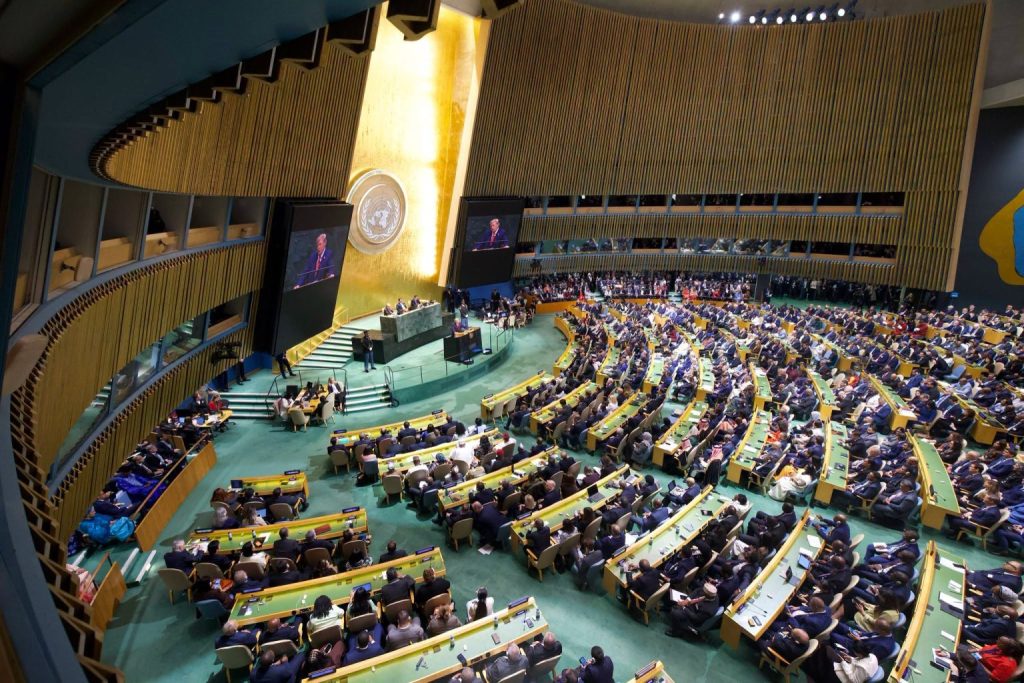
Macedonian citizens know where they belong. We are a NATO ally. The United States is our strategic partner. Full membership in the European Union is our strategic commitment. These are not three separate policies, Prime Minister Hristijan Mickoski emphasized at the 81st session of the United Nations General Assembly in New York.
It is a single geopolitical orientation, grounded in democracy, collective security, the rule of law, and an open economy. In times of uncertainty, our response is not strategic ambiguity. Our response is clarity. Yet, clarity in our alliances does not mean turning our backs on the world. Quite the opposite. It is precisely a state confident in its democratic and strategic choices that can engage and cooperate with greater self-assurance with countries that have different histories, different interests, and different political views. The world does not need another division into permanent camps—he said. Mickoski emphasized that the world needs competition with boundaries and rules that everyone must respect.
Alliances that take responsibility. And international institutions that keep the door open for dialogue precisely when dialogue is most difficult. That is why the United Nations is important. Not because it can resolve every conflict—obviously, it cannot. Not because every resolution is implemented—obviously, that is not always the case. But that should not discourage us. It should strengthen our resolve to protect the United Nations and the rules upon which it is founded, and to advocate for multilateralism rooted in values, mutual respect, and rules. For a world without a place where all states—regardless of size—can sit under the same roof and appeal to the same principles would be even more dangerous than the world we see today. In 1954, Dag Hammarskjöld reminded us of a thought: the United Nations was not created to lead us to heaven, but to save us from hell. Seven decades later, it is important to understand the essence of that statement—he said.
The Macedonian Prime Minister assessed that we should not expect perfection from the United Nations.
We should expect them to be effective. To possess the capacity to prevent and mediate. The capacity to protect human dignity. And, finally, the capacity to uphold principles even when their application is politically inconvenient. Today, trust in the international system is jeopardized precisely because too many people justifiably feel that the rules do not apply equally to everyone; that power sometimes takes precedence over principle; that obligations are conditional; and that agreements last only as long as interests remain unchanged. For small states, this is a particularly dangerous world. Our history has taught us that international compromises are extremely difficult and that peace, stability, and integration require political courage and great sacrifices. And—without wishing to sound didactic—if one seeks an example of a country that has repeatedly relinquished something that naturally belongs to it as a fundamental right—something many take for granted—one need only look at my country’s recent history. It is a history marked by challenges, by regional security risks, and by constant compromises and concessions made in the name of peace, cooperation, and the higher goals of integration—often at the cost of our most basic sense of dignity and justice,” he said.
Mickoski declared to the world that, as a state, we have made truly difficult decisions. We pressed ahead even when processes took longer than a single generation of citizens could reasonably have expected. Yet precisely for this reason—viewing those decisions with the benefit of hindsight and a clear understanding of reality—I can state responsibly today that trust cannot remain a one-sided obligation indefinitely. If small states are expected to abide by the rules, then those rules must also provide them with predictability. If candidates for membership in an organization are required to meet specific criteria, then fulfilling those criteria must lead to progress. If we ask citizens to trust institutions, then institutions must demonstrate that their word holds weight and that commitments made are enduring—said Mickoski.