

 English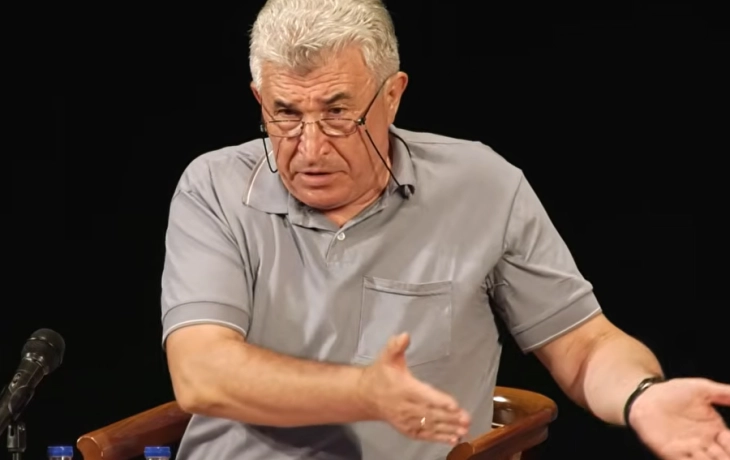
History professor Aleksandar Atanasovski from the UKIM university in Skopje, whose area of expertise is the Middle Ages, including the Byzantine era and the Empire of Tsar Samuil – was a guest on a Bulgaria radio show discussing the recent movement of his purpoted sarcophagus from Solun to Sofia. In the interview, professor Atanasovski discussed the event that Bulgaria is using as part of its political and historical campaign over Macedonia.
Professor, how was the news received in Macedonia that Tsar Samuil is returning – or “coming home” – to Bulgaria?
Well, he was never in Bulgaria; why would he be “coming home” when he was never taken from Bulgaria in the first place? The implication here is that we stole Samuil from Bulgaria and brought him to Macedonia, yet he was born in Macedonia, died here, and was buried here. I don’t know… what is this “news” about him returning to Bulgaria?! It is utter nonsense.
Where is he buried?
Now, that is a question worthy of a Nobel Prize. One thing is certain: he is not where they think he is, and the remains Bulgaria is taking do not belong to Samuil. First of all, regarding those four graves there – no one knows whose they are; there is no inscription, no evidence whatsoever. Initially, it was said that the grave was inside the church, beneath the slab featuring Persian ornaments—leading to the theory that he was of Persian origin. Some claim he died and was buried in Prilep, while others maintain he was laid to rest in an entirely different location. The only Byzantine source is Michael Attaleiates, who states that Samuel died at the “Marshy Lake”—or rather, on the “Marshy Island.” But where was he buried? In my opinion, Samuil’s remains were taken to Bulgaria as early as 1943, following Italy’s capitulation in World War II—and given that Italian forces had previously held the Prespa region—Bulgarian troops entered the area. An archaeologist (I believe his surname was Filov) arrived, and they conducted an investigation in the village of German on Lake Prespa, where Samuil’s father, mother, and brother had been buried. Logically, this would have been the family tomb, suggesting Samuil was buried there as well. Bulgarian soldiers transported all the remains discovered in German—specifically around those churches—to Sofia back in 1943–44. Consequently, it is possible that the remains were taken to Bulgaria at that time. The remains currently being retrieved are, in all likelihood, not Samuil’s. The remains found in those graves most likely belong to one of the priests. Evidence of this lies in Moutsopoulos’s initial findings: the position of the skeleton—the way the deceased is laid out (I am not sure how closely your politicians and archaeologists have examined this)—shows him lying on his back with a “headrest” (as we call it) beneath his head; specifically, there are three bricks arranged in the shape of the letter “Pi” (Π)—two placed vertically and one horizontally across the top—and he rests upon that structure. This type of burial practice is found neither in Bulgaria nor in Macedonia. This indicates that the person buried there was not from this region. Who knows where he was brought from—perhaps he was a priest from Asia Minor or somewhere else entirely. Such a burial method does not exist in the Balkans.
Professor, the sarcophagus containing the remains of Tsar Samuel, brought from Greece, has been placed in the Church of St. Sophia, where it will be on display. Do you know what is inscribed on the sarcophagus? “Samuil, in Christ God, Tsar of the Bulgarians.”
That was written by someone else; Samuil certainly did not write it. There is not a single document or record in which Samuil refers to himself as “Tsar of the Bulgarians.” In fact, he never refers to himself as “Tsar” anywhere; instead, he uses the title “Servant of God”—meaning Samuel, the servant of God. He is not referred to as “Tsar.” Byzantine authors unanimously label him a renegade and a tyrant; nowhere do they acknowledge his title of Tsar. Only Skylitzes, when discussing the fall of Ohrid to Byzantine rule, happens to mention the discovery of imperial palaces and pearl-adorned crowns there, though he does not specify whether they were imperial crowns or ecclesiastical ones. That is all the information we have. After the Battle of Spercheios, Yahya of Antioch recounts that negotiations for peace took place between Basil II and Samuel, and that Samuel offered submission; however—and this comes from a completely different source, not Skylitzes—just as Basil II was considering accepting the offer, Samuel proclaimed himself Tsar. Furthermore, there is no record anywhere stating that he styled himself “Tsar of the Bulgarians” or of any other people. We refer to the state as Samuel’s Empire or Samuel’s realm, but the extent to which it was truly an empire is another matter. It was a conglomerate—as Božidar Prokić noted long ago—a sort of contemporary federation of local princes who united under Samuel’s rule in opposition to both Boris II and Byzantium. Skylitzes clearly testifies to this in his chronicle.
So, in your view, Samuil is not a Tsar—not a Macedonian Tsar?
We cannot call him Macedonian; as I told you, it is nowhere designated as Macedonian, Bulgarian, or anything else. If you look at the symbols on the monument in Sofia—the one you erected—it bears the 16-rayed sun of ancient Macedonia, the symbol of ancient Macedonia. It also features the lion on the front. Look at the monument in Sofia; you are the ones who placed it there. Those are the ancient symbols from ancient Macedonia.