
 English
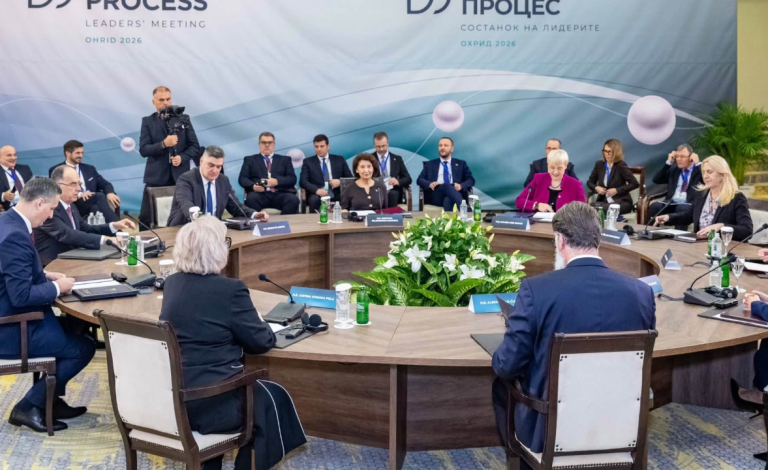
Intensifying regional cooperation, resolving outstanding issues, strengthening political dialogue, and accelerating the European integration process for the Western Balkans are just some of the topics addressed at today’s working meeting of the Brdo-Brijuni Process, held in Ohrid.
The meeting was attended by the presidents of Macedonia, Slovenia, Croatia, Montenegro, Albania, and Kosovo—Gordana Siljanovska-Davkova, Nataša Pirc Musar, Zoran Milanović, Jakov Milatović, Bajram Begaj, and Justina Shiroka-Pula—as well as the acting president of Serbia, Aleksandar Čupić, and the Chair and members of the Presidency of Bosnia and Herzegovina—Željka Cvijanović, Denis Bećirović, and Darijana Filipović.
Full and timely membership of the Western Balkan countries in the European Union is vital for the security, stability, and economic development of the region; furthermore, the accession process should once again be based on objective, predictable criteria and the reforms achieved. This was stated in the joint declaration adopted at today’s meeting of the Brdo-Brijuni Process leaders in Ohrid. In a joint statement, the leaders reaffirmed their full support for the European perspective of all Western Balkan countries, noting that enlargement brings benefits to the European Union and is increasingly recognized as a geopolitical necessity.
The document emphasizes that the progress of each candidate country should be assessed based on established criteria and its individual achievements in implementing reforms. It further notes that obligations arising from EU law and international agreements must be respected and effectively implemented—particularly regarding the rule of law—and that decisions concerning the further accession process should be guided by these principles as well as the Copenhagen criteria.
The leaders also highlight the importance of the EU Growth Plan as an instrument for economic integration and reform support, urging candidate countries to make full use of the available funds.
Special emphasis is placed on accelerating investments in sustainable transport, energy, and digital infrastructure, with the aim of improving connectivity both within the region and with the EU. The statement asserts that the Western Balkan countries should not be treated as third countries, but rather as an integral part of European infrastructure networks, economic integration, and future development. The final part of the joint statement highlights the need for greater involvement of young people in the Brdo-Brijuni Process, as well as increased attention to issues that concern them. The leaders welcome the cooperation between the directors of employment agencies and assess that it has the potential for further advancement.