
 English
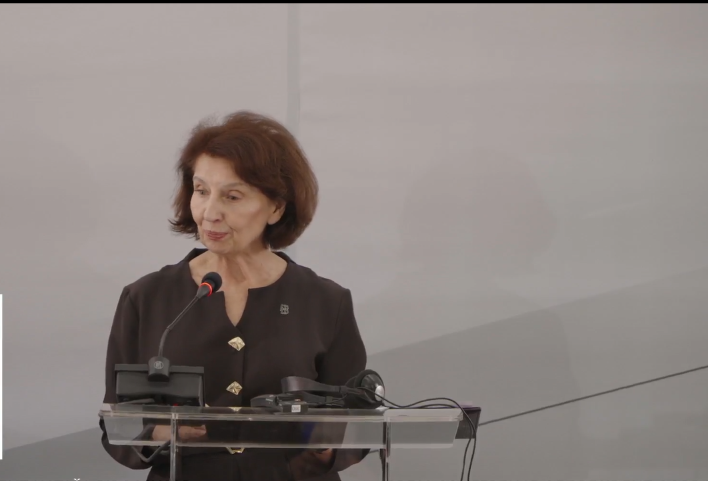
European Union enlargement is not merely a matter of expansion, but also a security imperative; furthermore, the progress made by Montenegro and Albania on their path toward membership is significant for Macedonia as well, stated President Gordana Siljanovska-Davkova at a press conference following the Brdo-Brijuni Process Summit in Ohrid.
Regarding Macedonia’s path toward European integration, Siljanovska-Davkova noted that the country faces a serious challenge concerning bilateral issues. She emphasized that these issues are unrelated to the Copenhagen criteria and do not constitute “Europeanization”; rather, they run counter to the principles and values enshrined in the European Union’s foundational documents.
She indicated that she does not view “gradual membership” as a substitute for full membership, though she acknowledged that the process does include some encouraging steps. Speaking on the significance of the Brdo-Brijuni Process, the President described it as one of the best and most inspiring regional initiatives, underscoring the importance of mutual listening, understanding, and support.
“Geography has dictated that we live side-by-side, and regional progress is vital—not only for the region itself but also for the European Union,” she said. As one of the key arguments for enlargement, Siljanovska-Davkova pointed to the region’s geopolitical position and the need for the European Union to strengthen its role on the global political stage.
“Enlargement is not merely a matter of expansion; it is a security imperative. If the European Union wishes to be a significant player on the complex global political stage, it must recognize the need to function as a geopolitical union. In other words, without the so-called Western Balkans, a geopolitical vacuum would be left behind—and in politics, a vacuum never truly exists,” emphasized Siljanovska-Davkova.
Siljanovska-Davkova expressed her gratitude to Slovenia and Croatia for their support of the Western Balkan countries on their path toward the European Union. She highlighted that, rather than offering only encouragement, both nations chose to embark on a shared journey and advocate for the region’s interests.
“Slovenia and Croatia could have simply said, ‘We have reached Brussels, and we encourage you on your own path there.’ Instead, they proposed that we travel together—acting as our voice, offering their support, and sharing the lessons they have learned. I will never forget this,” said Siljanovska-Davkova. She assessed that the summit featured an open exchange of views and mutual understanding, even when differing positions were expressed.
In response to a question about whether she had received a clear promise from Slovenia and Croatia that they would side with Macedonia in the dispute with Bulgaria, Siljanovska-Davkova stated that she had not requested such direct support, but noted that both countries consistently express their backing for Macedonia.
“We discussed the need for ‘de-bilateralization,’ particularly regarding issues of identity. The support from both nations is clear—both within the Brdo-Brijuni Process and elsewhere; they consistently affirm that they stand with us,” the President said.
She pointed out that the principles outlined in the declaration adopted at the summit pertain both to relations with neighbors and to bilateral issues. She added that, in her view, there is a consensus among the participants regarding the principles and values associated with EU enlargement.
Addressing a question about relations between Macedonia and Serbia, Siljanovska-Davkova described them as traditionally good and expressed an expectation that they would be further strengthened. She noted that there are no unresolved issues between the two countries, emphasizing that the specific model of democracy is an internal matter for each individual nation. “Traditionally, Serbian-Macedonian relations are good. I expect them to become even better. I believe there are no unresolved issues between us, nor have we faced any. The model of democracy is an internal matter for each state,” said the President.