


 English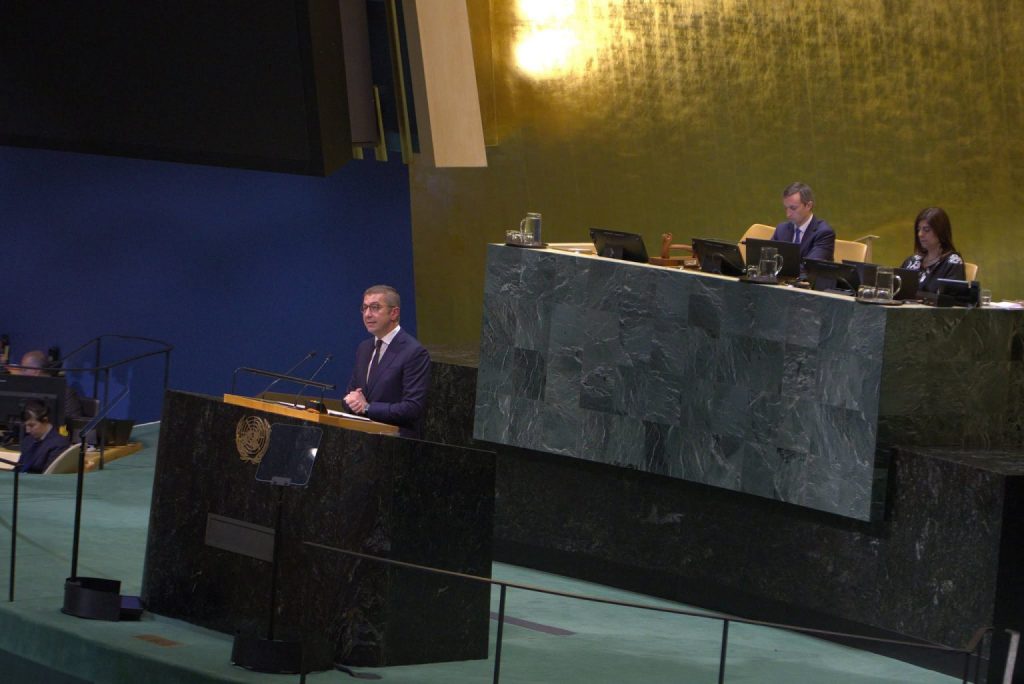
In the new geopolitical landscape, nations are no longer guided solely by where a specific product can be manufactured at the lowest cost. Questions regarding who can be trusted, whether energy will remain available during a crisis, and who will set the rules governing new technologies are becoming increasingly critical, stated Prime Minister Hristijan Mickoski from the podium of the United Nations General Assembly in New York.
According to him, the future will also depend on the ability of societies to timely understand and manage the changes brought about by technology.“Artificial intelligence is no longer a topic of the future; it is the infrastructure of the present,” the Prime Minister emphasized.He noted that the world is once again recognizing the value of resilience, secure energy supplies, high-quality infrastructure, diverse transport routes, and close, reliable supply chains.In this context, the Prime Minister highlighted the intensive development of Corridors 8 and 10 as part of a broader European vision for infrastructural and economic connectivity.The goal is to better connect the Adriatic, Black, and Aegean Seas with Central Europe and to secure more reliable routes for the movement of goods, energy, and people. With the development of these corridors, the region should become interconnected in terms of infrastructure and cease to be treated as a geopolitical periphery.“Our geography need not be our destiny; it can become our advantage,” the Prime Minister stated.To achieve this, it is necessary to build institutions and infrastructure that will transform Macedonia’s geographical location into genuine regional and European connectivity.