


 English
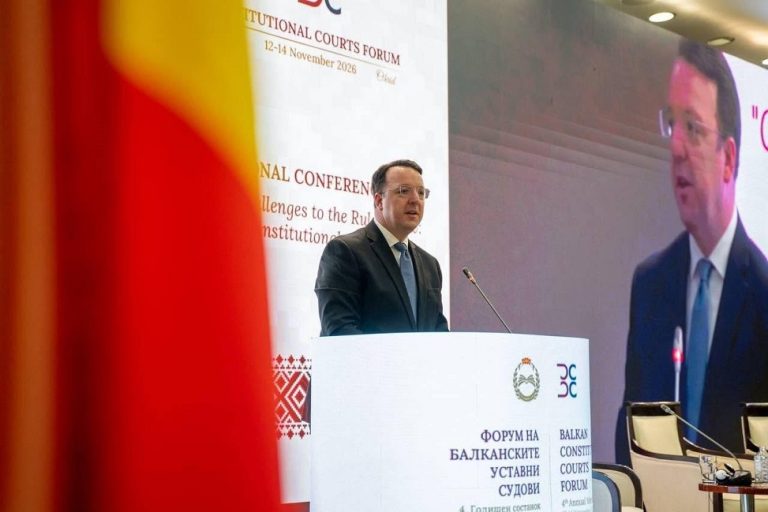
As a Government, we are making every effort to establish a functional system of the rule of law as the foundation of a democratic state, and here, of course, one of the key actors is the Constitutional Court, which has a special and irreplaceable role in preserving the constitutional order and protecting fundamental rights and freedoms, Deputy Prime Minister and Minister of Transport Aleksandar Nikoloski said in his address at the fourth annual conference of the Forum of Balkan Constitutional Courts, held in Ohrid on the topic “Contemporary Challenges to the Rule of Law: The Role of Constitutional Courts.”
Nikoloski stressed that the role of the Constitutional Court is particularly important in this time of rapid social, technological, and political changes. As he put it, “that is why institutions must be stable, institutions must be resilient, and institutions must survive political changes.”
The independence, professionalism, and integrity of constitutional judges and of the Constitutional Court are key to fulfilling this function. The rule of law implies not only the adoption of high-quality decisions, but also their respect and implementation. The executive and legislative branches have the responsibility to create the conditions for the full implementation of the decisions of the Constitutional Court, which very often also mean a correction of certain decisions that may have been taken without sufficient analysis and without sufficiently taking all the facts into account, and sometimes even with some other intention. That is why the foundation of the Constitutional Court is precisely this — to help make corrections where corrections need to be made, Nikoloski pointed out.
He noted that respect for constitutional justice is an indicator of a state’s institutional maturity and democratic responsibility.
That is why we strive to respect the Constitutional Court and to give it the place it deserves in the state-legal order. The independence of the judiciary should, of course, not be understood in isolation from the other institutions, but rather as a guarantee of impartial and objective decision-making, and also as a way of improving society. Mutual control and balance among the three branches of power — and here, of course, the Constitutional Court as a separate body — play a significant role in maintaining a functional state, Nikoloski emphasized in his address before constitutional judges from the country and abroad.
The Deputy Prime Minister also referred to the new challenges, such as digitalization and artificial intelligence, which on the one hand can be an advantage, but on the other hand also a threat.
Of course, knowledge, experience, and the human factor remain irreplaceable, and I cannot agree with certain debates that are being conducted, that even in this area — in the area of respecting the Constitution, in the area of implementing the Constitution, and in the area of implementing and respecting the laws — we should rely on artificial intelligence. I think that is wrong, and I think it is something that we need to think about very seriously as a state and as states, because this is a broader debate, not only in our country, but I repeat, I believe that is not the path we should follow, because knowledge and personal experience are something that is irreplaceable and that no machine can do, Nikoloski said.
At the closing of the Forum of Balkan Constitutional Courts, Deputy Prime Minister Nikoloski stressed that a strong state does not mean only a strong executive power, but a limited executive power, a state with strong and independent institutions, institutions that complement each other and control one another.
Therefore, as a representative of the executive branch, as Deputy Prime Minister, I can say that as a Government we will do everything and we are doing everything for this system to continue to function and to be further developed, Nikoloski said.