


 English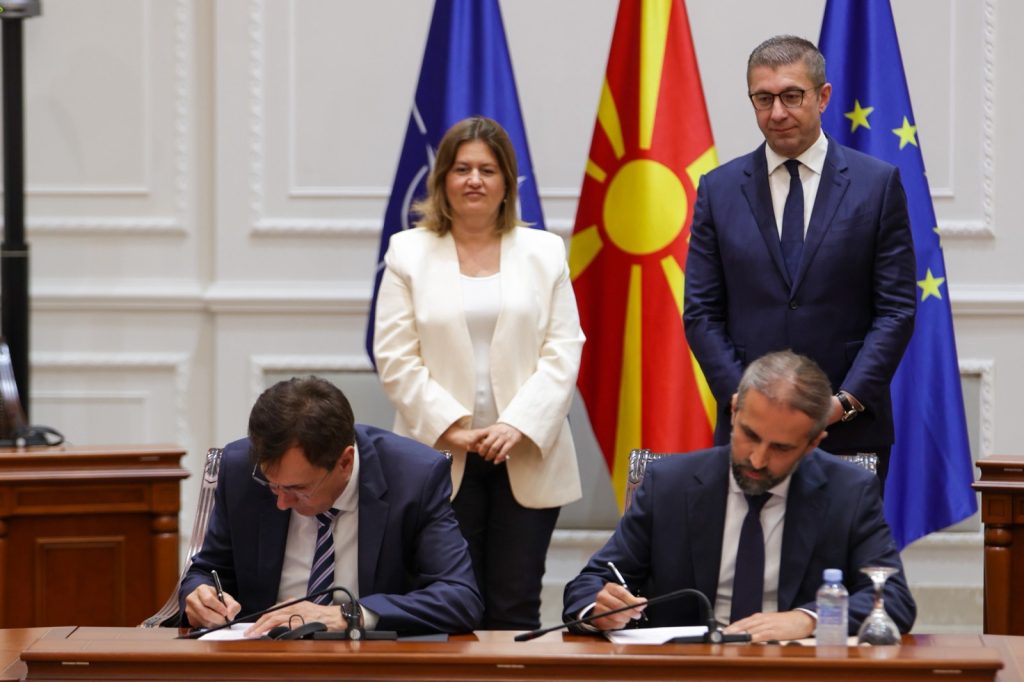
The construction of the gas interconnector between Macedonia and Serbia will enable full vertical connectivity along Corridor 10 and will significantly strengthen the country’s geostrategic position, the Government assessed.
The Government points out that after the completion of the interconnector with Greece, which is expected in the first half of next year, and the interconnector with Serbia, whose implementation is expected by the end of 2028, Macedonia will be connected to the energy systems in the north and south.
After the completion of this project and the completion of the interconnector with Greece, and then with our northern neighbor, Serbia, we will get a full vertical connection that is part of Corridor 10 and the geostrategic position of the country becomes dramatically more significant, said Prime Minister Hristijan Mickoski.
As he pointed out, Macedonia, as a landlocked country, improves its geostrategic position through connections to the ports and energy systems of neighboring countries. In this context, the connection with the terminal in Alexandroupoli, the port of Thessaloniki through the product pipeline and the “OKTA” refinery, as well as the electricity interconnectors with neighbors, stands out.
Of particular importance, according to the Government, is the fact that the gas pipeline with Serbia will be bidirectional, which further increases its strategic and regional value.
The Government highlights the hiring of a Macedonian company to carry out the works as a second significant aspect.
A Macedonian company will carry out the work, and that is very important for the Macedonian economy. It is our priority as a Government – for Macedonian companies to carry out such strategic projects, of course within the capacity that we have as a state and as a construction operation, said Prime Minister Mickoski.
From there, they expect the contractor company to use its experience and respect the deadlines stipulated in the contract.
The third priority is the strategic goal of Macedonia becoming a crossroads of the two pan-European corridors – Corridor 8 and Corridor 10. According to the Government, this goal should be based on three pillars – road infrastructure, i.e. highways and expressways, energy connectivity and other infrastructure projects connecting the country with the region.
In this context, the possibility of building a gas pipeline connection with Kosovo is also being considered. A feasibility study is being prepared for this route, and the Government believes that despite Kosovo’s current position that there is no need for such a connection, the conditions may change in the future due to new European Union regulations.