
 English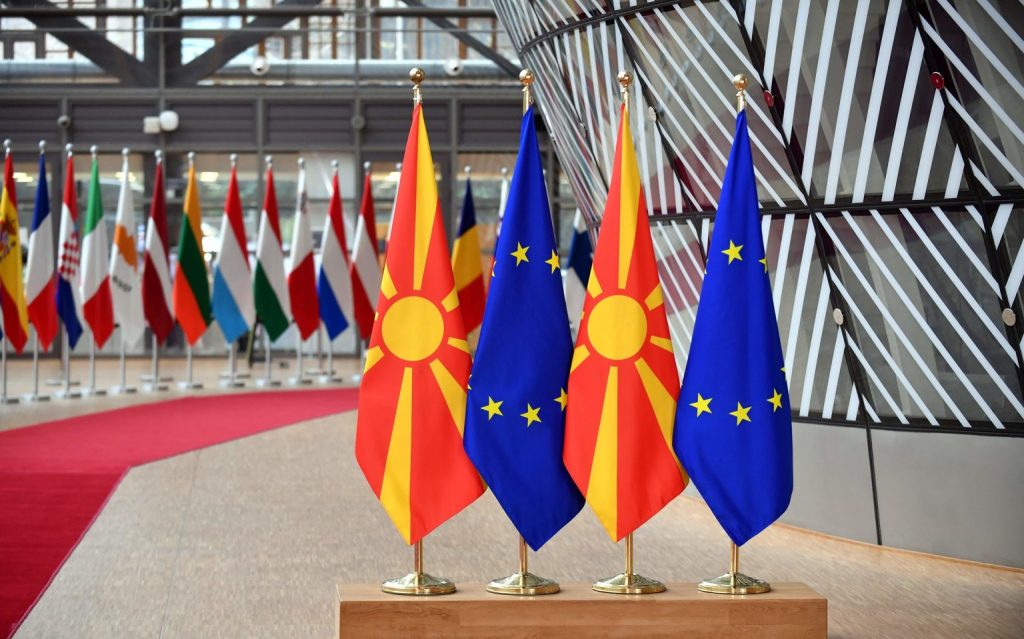
Macedonia will not abandon the European idea due to the arduous and lengthy path to membership; however, it expects integration to remain a process based on merit and measurable criteria, rather than having the goalposts constantly shifted by bilateral issues, the Prime Minister stated from the podium of the United Nations General Assembly in New York.
Addressing the General Debate at the 81st session of the UN General Assembly, the Prime Minister emphasized that the European Union remains Macedonia’s natural political, economic, and institutional home.
“We will not give up on the European idea simply because the European path has been difficult,” he declared.
At the same time, the Prime Minister acknowledged that Macedonia has significant work to do at home. It is necessary to strengthen the rule of law, build more efficient institutions and a more competitive economy, and restore citizens’ trust in their own state.
In his view, this is a domestic responsibility that Macedonian authorities must not—and will not—shift onto Brussels.
“That is our responsibility, and we will not shift it to Brussels,” the Prime Minister emphasized.
However, alongside the reforms Macedonia must implement, the European Union also has an obligation to ensure a credible, predictable, and fair integration process. Macedonia expects progress toward membership to depend on meeting clearly established criteria, rather than on additional conditions stemming from bilateral relations with individual member states.
“We are not seeking an easier path. We seek a path governed by rules. We are not asking for lower standards; we ask that standards remain standards,” the Prime Minister stated.
He warned that confidence in the European process is undermined when criteria are altered while the process is already underway, or when meeting established conditions fails to lead to the expected progress.
If candidate countries are required to meet specific criteria, then fulfilling those criteria must be duly recognized and valued. Otherwise, it is difficult to expect citizens to maintain their belief in integration, compromise, and the value of the commitments undertaken.
The Prime Minister emphasized that, in recent history, Macedonia has made difficult decisions and significant concessions for the sake of peace, good-neighborly relations, and the ultimate goal: integration into European and Euro-Atlantic structures.
The country continued to move forward even when processes took longer than a single generation of citizens could reasonably have expected. For this very reason, he argued, the rules must not be changed based on the shifting balance of political forces. The commitments undertaken must hold lasting value and serve as a foundation upon which citizens can plan their future.
Macedonian citizens are asked to believe in cooperation, good-neighborly relations, compromise, and mutual respect. However, this becomes increasingly difficult when they see that any compromise made might be followed by a new demand.
According to the Prime Minister, a credible enlargement process is not only important for Macedonia and other candidate countries; it is equally important for the European Union itself.
Europe’s future geopolitical weight will increasingly depend on its ability to translate promises into concrete political results, to consistently uphold the values it advocates, and to remain steadfast in advancing them despite the challenges it faces.
As the Prime Minister stated, Macedonia remains committed to European Union membership and to meeting European standards. At the same time, however, it expects the Union to demonstrate that its rules apply equally, that criteria are measurable and fixed, and that progress achieved yields tangible results.