
 English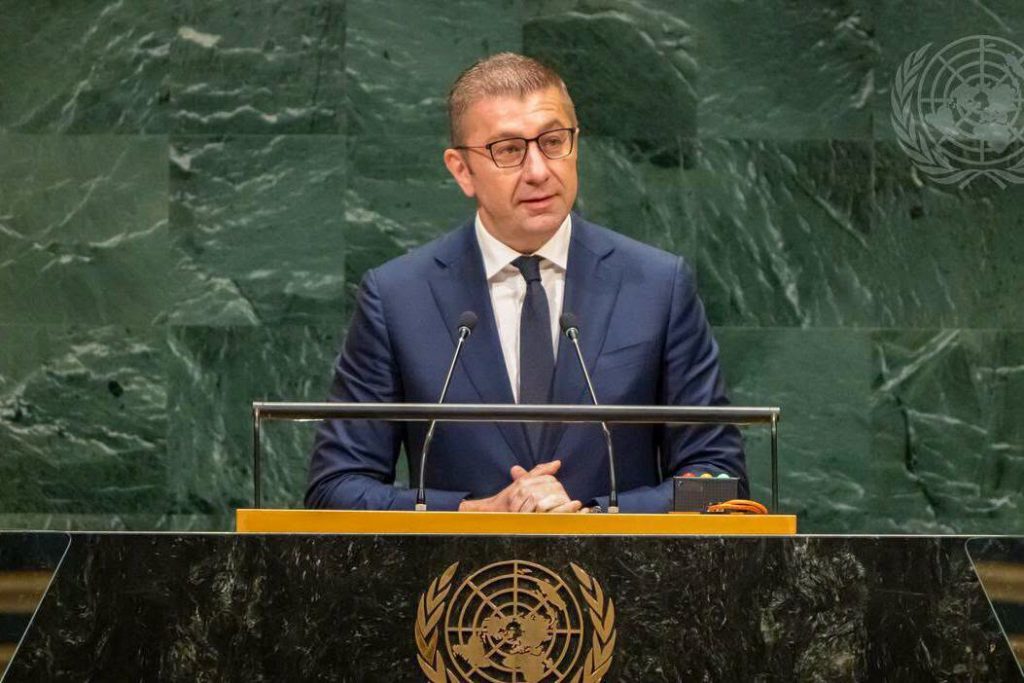
Trust cannot remain a one-sided obligation indefinitely, and the international order must ensure equal rules, dignity, and predictability for both small and large states alike—this was the message delivered by Prime Minister Hristijan Mickoski during his address at the General Debate of the 81st session of the United Nations General Assembly in New York.
In his speech, the Prime Minister addressed the changes brought about by artificial intelligence, the new energy and security landscape, and climate and demographic challenges. He also touched upon issues such as war, displacement, education, migration, European integration, and the position of small states in a world where power increasingly takes precedence over principles.
He began his address by speaking of the generation of children who will sit at school desks for the first time this autumn and who, by 2040, will be on the threshold of adulthood. As he noted, while the exact nature of the world they will inhabit remains unknown, it is certain to differ from the world of today.
Artificial intelligence will transform professions, industries, and decision-making processes; the energy sector will operate according to a new logic; and climate change will impact economies, agriculture, cities, and the movement of people. Demographic changes, meanwhile, will reshape labor markets and social protection systems.
Security, as he emphasized, will no longer depend solely on armies and borders, but also on power grids, data centers, cables, satellites, algorithms, and trust in the information we receive every day.
Despite immense scientific and technological progress, millions of people continue to live in war or under the threat of war, more than a hundred million are forcibly displaced, and over 270 million children and young people are out of school.
“That is the paradox of our time. Humanity has never possessed such vast scientific and technological capabilities, yet it has never been more evident that technological power does not automatically generate political wisdom,” the Prime Minister stated.
According to him, the real question facing the General Assembly is not merely how crises will be managed in 2026, but what kind of international order will be left to the generation starting school today. For a small state, he emphasized, this is not an academic matter, but a question of survival.
Recalling Macedonia’s admission to the United Nations 33 years ago, the Prime Minister noted that the world looked very different back then. The Cold War had ended, and there was hope that a new era was beginning in which cooperation would gradually replace conflict.
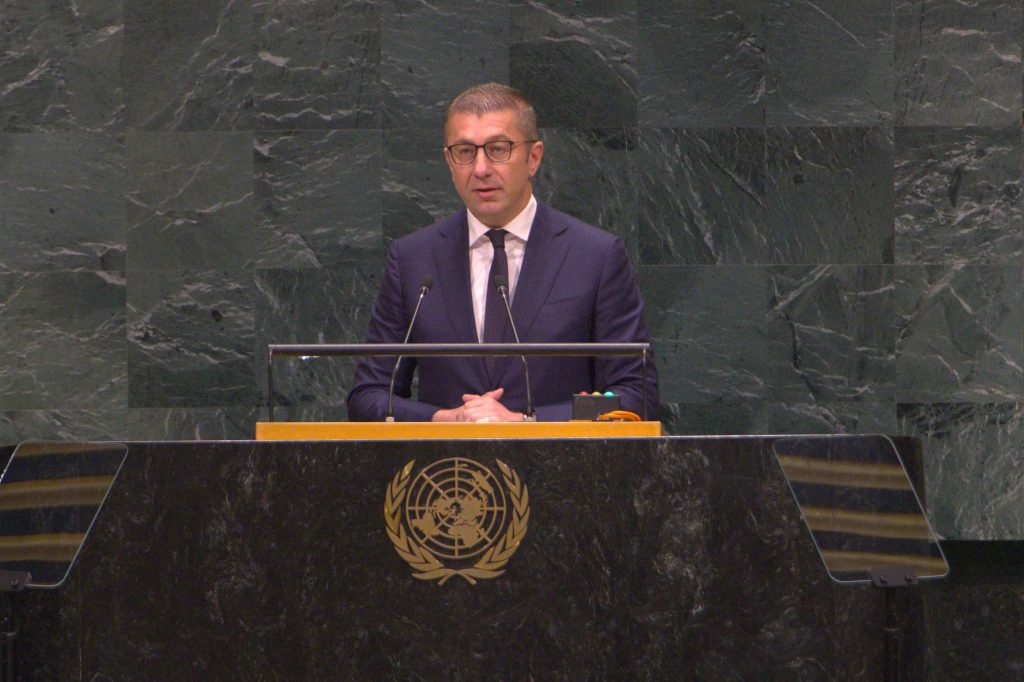
Trust in the international system, he warned, is at risk because too many people justifiably feel that the rules do not apply equally to everyone, that power sometimes takes precedence over principles, and that agreements last only as long as interests remain unchanged.
Reflecting on recent Macedonian history, the Prime Minister pointed out that the country has repeatedly relinquished things that naturally belong to it as a fundamental right—things that many others take for granted.
That history, he said, is marked by challenges, regional security risks, and constant compromises and concessions made in the name of peace, cooperation, and the higher goals of integration—often at the cost of the most basic sense of dignity and justice.
Macedonia has made difficult decisions and pressed ahead, even when processes took longer than a single generation of citizens could reasonably have expected.
“That is precisely why I can state responsibly today that trust cannot be an endlessly one-sided obligation,” the Prime Minister declared.
If small states are expected to abide by the rules, then those rules must also provide them with predictability. If candidates for membership in an organization are required to meet certain criteria, then fulfilling those criteria must lead to progress. If citizens are expected to trust institutions, those institutions must demonstrate that their word holds weight and that the commitments they make are enduring.
A rule valid today cannot simply change tomorrow just because the balance of power has shifted; a commitment undertaken must not be a matter of temporary political expediency, but rather a foundation upon which people can plan their futures.
Citizens are asked to believe in cooperation, good-neighborly relations, compromise, and mutual respect. They are told that lasting peace is more valuable than a short-term political victory, that honoring agreements is a sign of strength and wisdom, and that European and Euro-Atlantic integration entails accepting rules that apply to everyone.
However, the Prime Minister warned, that argument becomes much harder to defend when citizens see principle sometimes giving way to power, criteria shifting while the process is underway, and a level of consistency demanded of some that others do not require of themselves.
“We cannot tell people to ‘trust the rules’ when they see that the rules do not apply equally. We cannot convince them that compromise is a virtue if every compromise brings a new demand,” he emphasized. According to the Prime Minister, this is a matter of legitimacy, because the authority of elected leaders stems not only from their office but also from the citizens who elect them, demand accountability, and compare what is said with what they see on a daily basis.