
 English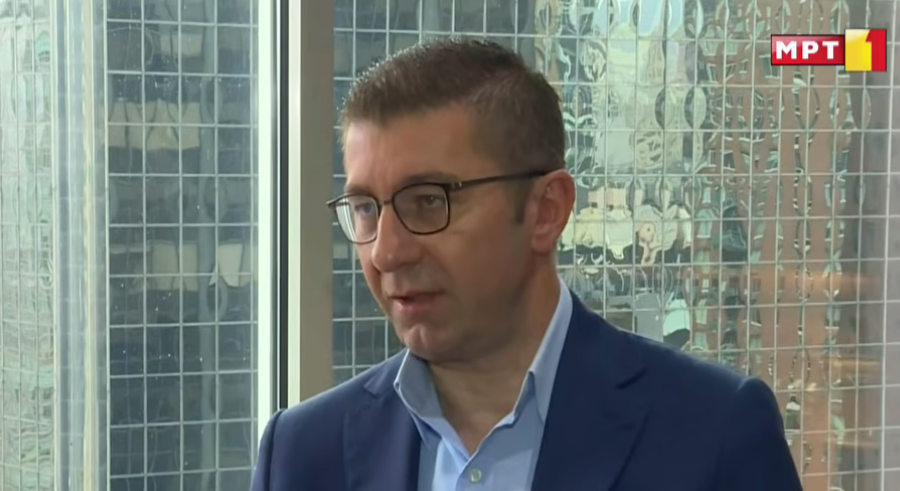
I cannot speak to exactly how much we can expect from our strategic partner, the United States, regarding our integration into the European Union. I can only say that we are seizing every opportunity to present our arguments. That is what matters to me, and that is what matters to the people in the government,” Prime Minister Hristijan Mickoski noted in an interview with MRT from New York.
“Because too many times in the past, we witnessed situations where the arguments presented were not really arguments at all—or rather, there were no arguments. There was only nodding, kneeling, and bending the spine; that was essentially the foreign policy during the last seven years under the SDSM government. That was the behavior of the SDSM and DUI officials—they were completely uninterested in any arguments aimed at defending our country’s state and national positions. So, that is essentially our goal right now: to try to convey our positions and arguments, and then let our interlocutors judge for themselves whether we are right or wrong,” Mickoski said. When asked how he interprets Sofia’s stance on proceeding bilaterally rather than with European Union assistance, Mickoski points out that the bilateral meetings held so far—whether by the President, the Foreign Minister, or the Minister of Foreign Trade—amount to nothing more than meetings for the sake of meeting.
“And then, once those meetings conclude, you get briefings from the respective parties—each presenting a version of events completely different from what was actually discussed. Our idea behind involving the European Union is to ensure that both our arguments and the other side’s arguments are heard. I am aware of the concerns held by official Sofia. They argue that sitting down with a third party present implies the existence of a genuine bilateral dispute. And indeed, we *do* have a bilateral dispute. We could try to invent excuses or pretend otherwise, but the reality is that we have a bilateral dispute that is currently in its early stages. And while it is still in the early stages—as I stated in my speech yesterday—we need to engage in dialogue. That is precisely why we need representatives from multilateral organizations—in this case, the European Union—to hear the arguments.” Fine—if the arguments of our counterpart (as I would call them in this instance) align with ours, we will say, “All right, you are right; forgive us, we were mistaken—it is what it is.” But it is important that they be heard. They won’t want to, though. They will constantly try to tell official Brussels, “Look, we held negotiations, we sat down and talked,” but insist that the constitution must be changed before anything else happens—that is their position, the Prime Minister said in an interview with MRT.
The Prime Minister indicated that he and the government are prepared to keep talking until a solution is found.
“Our position is that we cannot embark on any sort of risky venture without knowing that the end is within reach and clearly in sight. We would not want to enter a process where the goalposts keep shifting. Why? Because—and I will be completely open and direct here—even if we were to open negotiations tomorrow, every single chapter and cluster would require a vote in the national parliaments of EU member states upon its closure. That presents at least eighty opportunities for us to face new demands. What would that look like?” Some more radical faction will likely emerge in our eastern neighbor’s parliament, and then these mainstream politicians will say, “You know, we have to block them again now due to domestic issues—you know, Russian influence, this kind of influence; we are fighting against that Russian influence; you know, they are the ‘bad Russians’ and we are the ‘good Brussels-aligned ones'”—and that is roughly how it will all play out. I am not going to engage in that process. That is why we have proposals on how to move past this situation and how to work through it together. After all, we are partners in another multilateral structure—the NATO alliance. So, if we are partners there, within that family, logic dictates that we should be partners here as well. And at the end of the day, it is in official Sofia’s interest, too, for us to be part of the European Union. That is what good-neighborly relations are all about. We are ready to talk, and we will keep talking until we find a solution. That is democracy. That is the modern world: talking—talking as long as necessary—to reach a mutually acceptable solution. “As for entering a process where—forgive me—people are talking, with some briefing one thing and others another, where there is neither form nor substance… I have no desire to waste their time, nor do I wish to waste my own,” Mickoski pointed out.