
 English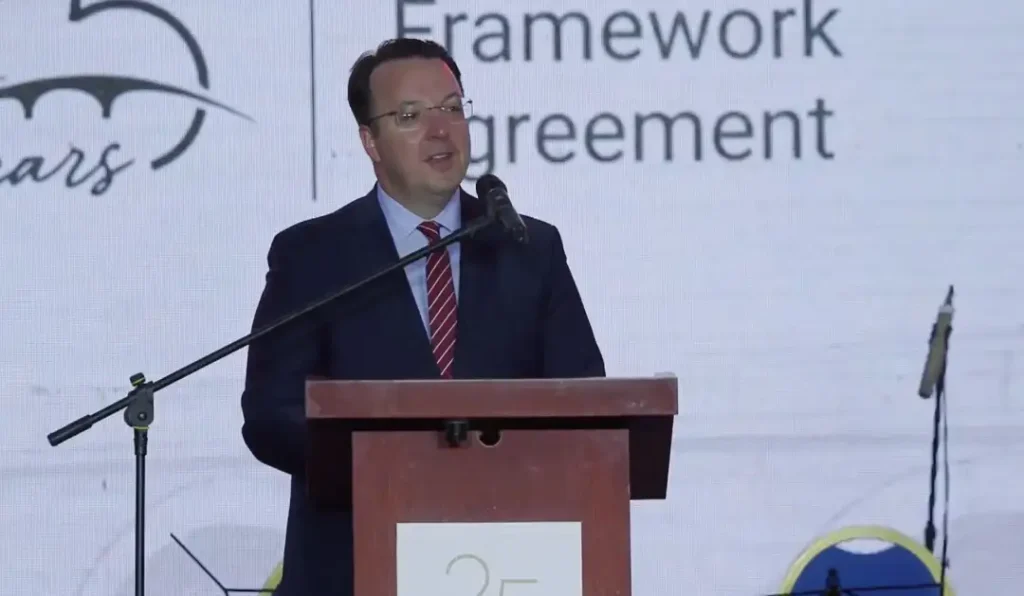
The Ohrid Agreement was not an agreement between winners and losers, but an agreement that gave the country the opportunity to move forward, to develop and to pave the way for future generations. Coexistence does not mean just living next to each other, but also with each other and for each other. Today, we are not looking back to the past to revive old divisions. We are looking back to it to better understand what kept us together, it was emphasized at the event held tonight on the occasion of the 25th anniversary of the signing of the Ohrid Framework Agreement under the auspices of the Ministry of Inter-Community Relations.
Deputy Prime Minister and Minister of European Affairs Bekim Sali said that one of the most important lessons of these 25 years since the Ohrid Framework Agreement is that our diversity is not a weakness, or even a challenge, but a value that makes us more valuable and virtuous.
Our strength lies precisely in the ability to transform our diversity into our value and into energy for development. Therefore, coexistence does not only mean living next to each other, but also with each other and for each other. True coexistence means building together and taking responsibility together, rejoicing together in successes and sharing difficulties together, Sali added.
Deputy Prime Minister and Transportation Minister Aleksandar Nikoloski said that 25 years is a sufficient period of time to be able to make a realistic historical review of what has happened and what should come before us. The Ohrid Agreement, he pointed out, was not an agreement of winners and losers, it was an agreement with which the state was given the opportunity to move forward, to develop and to pave the way for future generations.
25 years ago, the greatest victory was that it was possible to set a trajectory and a path that leads forward. It is true that there were years of distrust, of uncertainty, of political crises, but it is also true that this agreement was perceived differently or is still perceived differently today by different structures in society, but what is truly commendable is that the majority of citizens accept and respect it. There were and still are politicians who deliberately and occasionally inflame ethnic divisions and raise issues in order to achieve their political interests and use nationalism as a tool for personal and family enrichment. Those politicians are now in opposition and fortunately they are not part of this government. I assume that they are aware that their time is over and that the time of abuses, of manipulations is long behind us, said Nikoloski.
The state, he emphasized, is being built up like never before, and today we are setting a path for the future, whether it is investments in infrastructure, education, healthcare or social services, whether it is the extraordinary performance in the implementation of the EU growth plan or our strong contribution within NATO.
This is how we develop the country and this is how we will continue. In a few days we will start building the Skopje-Blace highway, during September we will start building the highway from Bukojcani to Kuchevo, I expect during October to launch another section of the Kicevo-Ohrid highway, and already in the first quarter of next year to completely complete the Kicevo-Struga-Ohrid highway. We will also build Bitola-Prilep, we launched Gradsko-Drenovo-Faris, we launched Kumanovo-Kriva Palanka, we are starting to build the expressway Kocani-Vinica-Delchevo-border with Bulgaria and Radovish-Strumica-Novo Selo-border with Bulgaria. In the railway sector, we are working intensively on Corridor 8 and the connection with Bulgaria, and I expect, in cooperation with the EU, to start working on the first phase of the western wing next year, which would run from Skopje through Jegunovce, Tetovo to Gostivar, the second phase Gostivar-Kicevo and the third phase Kicevo-Ohrid-Struga border with Albania. There is also Corridor 10 and the high-speed railway, which should give a new economic and political impulse to the country and thus position Macedonia as a true crossroads in the Balkans, Nikoloski stressed.