


 English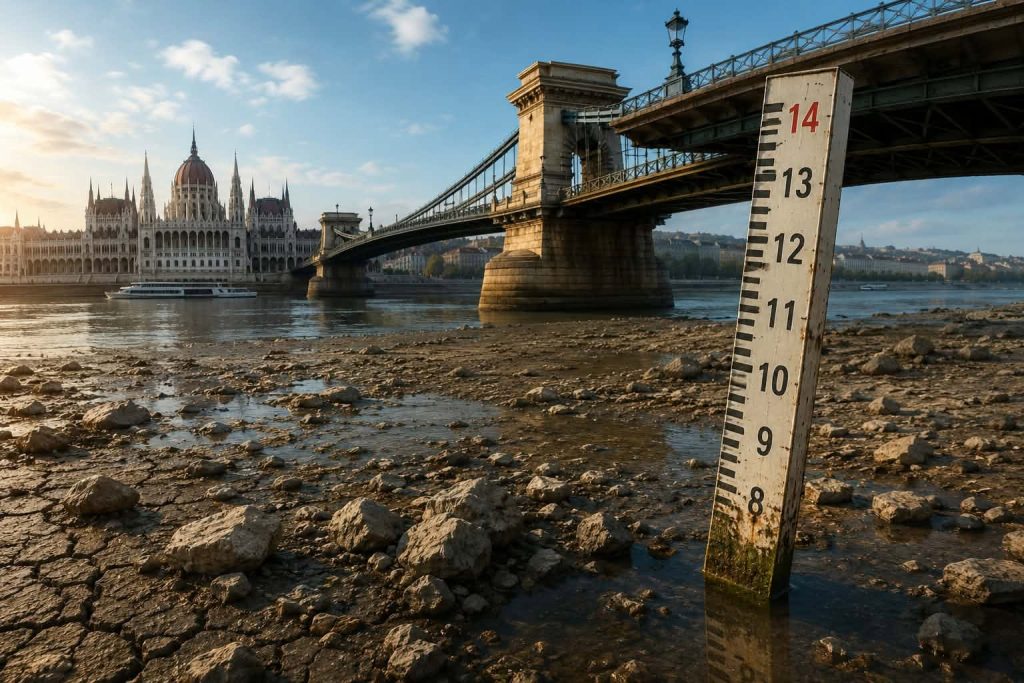
Levels of the Danube river in Budapest reached a historic low. According to the latest data from the Hungarian Hydrological Service, this morning the water level in the capital was only 16 centimeters, and during the day it is expected to decrease further – to about 13 centimeters. A drop of up to about 8 centimeters is forecast for tomorrow.
The extremely low water level is a consequence of the long-term drought and high temperatures in Central Europe. Satellite images from the European Space Agency show that the Danube in Hungary is at a record low level, and such extremes have become increasingly common in recent years.
The retreat of the river in Budapest has revealed parts of the riverbed that are usually underwater. The famous “Famine Rock” – a rock near Gellert hill that is traditionally visible only during extremely low water levels – has reappeared. Various objects and remains of the past are also emerging from the river, including archaeological finds, parts of old vessels and objects related to military history.
The consequences, however, are not only visual. The extremely low water level has also hit the energy sector hard. Hungary’s Paks nuclear power plant, which is cooled by water from the Danube, has had to significantly reduce production during the crisis. According to Reuters, production was at one point reduced to just 10 percent of capacity, before partially recovering. To ensure sufficient water for cooling the reactors, Hungarian authorities have also taken extraordinary measures. Two barges, each about 80 meters long, have been sunk near Paks to temporarily raise the level of the Danube by about 20 centimeters. A permanent underwater barrier in the riverbed is also planned, which could raise the level by about one meter.