


 English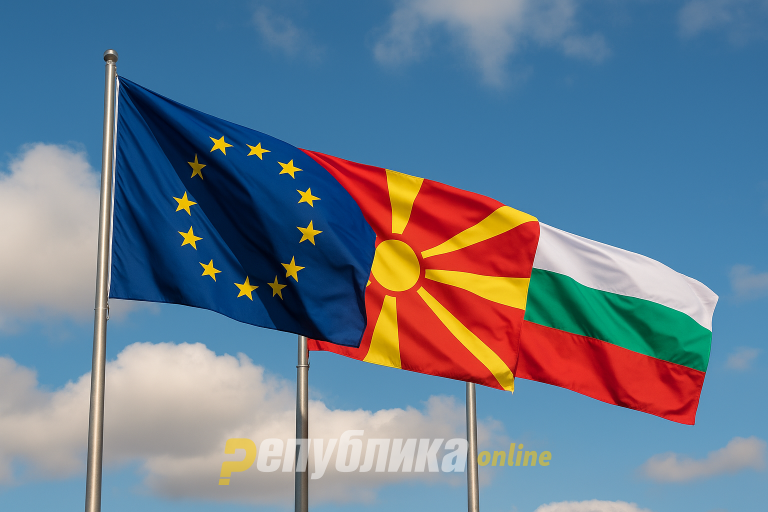
Deputy Prime Minister and Minister of Transport Aleksandar Nikoloski believes that if the appetite for enlargement returns among five or six major European Union member states, the issue with Bulgaria will not be a primary obstacle to Macedonia’s European integration. Appearing tonight on Alfa TV’s program “Kolegium,” Nikoloski assessed that, alongside the European integration process, the country must continue with reforms and economic development.
My key argument—and I stand by it—is that if the appetite for enlargement returns, particularly among five or six major EU member states, the problem with Sofia will be resolved. However, I want to be very precise: I am not referring to an appetite for enlargement in Brussels, the European Commission, or EU institutions; rather, I mean an appetite for enlargement among five or six larger and more influential EU member states. If that appetite does not return, we will remain in our current situation. Nevertheless, our task is to implement reforms, strengthen the country economically and politically, and build a modern state, Nikoloski stated.
He also addressed European financial support and infrastructure projects, highlighting that the country is receiving significant EU grant funding for railway and road sections. “We have a €149 million grant for the first phase of the railway and another approximately €30 million for the second phase, which is currently underway. We have €20 million for the highway, where work has already begun; all of these are grant funds. We also have €130 million for the Skopje–Blace section, construction of which has started. These are significant grant components that we are receiving from the European Union,” said Nikoloski.
Regarding the construction of the railway line to Bulgaria along Corridor 8, he reported that the section from Beljakovce to Kriva Palanka is already 40 percent complete and announced it would open to traffic next year; however, he noted that the full railway connection for the eastern branch of Corridor 8—stretching from Skopje to the Black Sea and Odesa—is expected to be completed in 2032.
There is currently a procurement process in progress—and I am very pleased that it was published on the European Union’s official public procurement platform rather than the Macedonian Public Procurement Bureau. It remains open until January 20, in accordance with European Investment Bank rules. I hope we will select a contractor on time. We also have a concurrent tender for supervision services, and I expect construction on that section to begin in April or May of next year. “It must be completed within five years—that is, by around 2032. In parallel, we will also build the railway tunnel connecting to Bulgaria; we have agreed that they will work on their section, so that by 2032 we will have a complete rail link from Skopje to the Black Sea and Odesa,” said Nikolovski.