


 English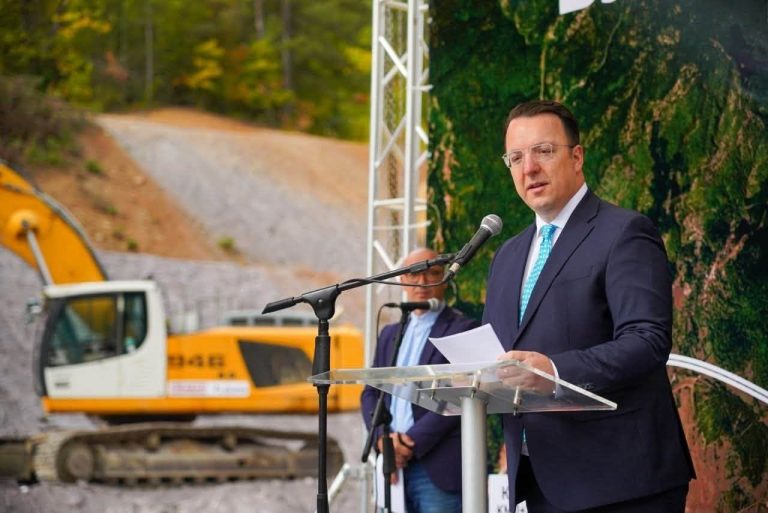
Macedonia is undergoing a period of intensive infrastructure development, with the simultaneous construction of six highway sections—investments intended to significantly improve the country’s road connectivity and provide a new boost to the economy. “This is a massive construction undertaking that few countries in the region, or even beyond, can boast of,” stated Deputy Prime Minister and Minister of Transport Aleksandar Nikoloski. Speaking on Alfa TV’s program “Kolegium,” he noted that the Government is not doing this as a competition, but rather to leave a legacy for future generations.
“We are not doing this for the sake of competition, but to leave something behind. Our terms in office will end—just as they did for our predecessors and will for those who follow—so the question is what legacy we leave behind and how future generations will remember us,” Nikoloski said.
He also pointed out that the Kichevo-Bukojchani highway is crucial for Corridor 8 and for the full functionality of the highway link connecting Skopje—via Tetovo, Gostivar, and Kichevo—to Ohrid and Struga. Importantly, as he emphasized, the work will be carried out by Macedonian operational teams, and the supervision will be entirely Macedonian. “The top Macedonian engineers and most qualified experts will work on supervising the highway project; this offers them valuable experience to gain knowledge and build a track record for competing on international markets. Furthermore, based on information from the Austrian consortium contractors, a significant number of Macedonian companies will be collaborating with them,” noted Nikoloski.
Nikoloski pointed out that the project involves exceptionally challenging mountainous terrain, requiring the construction of a 370-meter-long tunnel, five large viaducts, four smaller bridges, five overpasses, four underpasses, and two interchanges. He also highlighted the participation of domestic engineering firms as a particularly important aspect.
“The Kichevo-Bukojchani highway is a project of immense importance; it completes the highway route running from Skopje through Tetovo, Gostivar, and Kichevo to Ohrid and Struga. It is also crucial for Corridor 8, because without this highway, the other three highway sections currently under construction—Ohrid-Kichevo, Bukojchani-Gostivar, and Gostivar-Tetovo—would lack coherence, as they could not be linked together. This highway gives the entire Corridor 8 project its full purpose,” Nikoloski stated. The Deputy Prime Minister also discussed the construction progress of the other highway sections, noting the expectation that construction deadlines will be met across the board.
“Work on the Prilep-Bitola highway is proceeding at an excellent pace; while the completion deadline is the end of 2029, I expect that by next year, we will have opened about twelve of the forty kilometers. The Tetovo-Gostivar section—though it may appear straightforward—involves numerous structures and presents challenges; however, these are being addressed, and I expect it, too, to be completed by the end-of-2029 deadline. The Gostivar-Bukojčani section—or the Straža bypass—is the most difficult to build because the entire route runs through mountainous terrain and requires many bridges; in fact, work on the eighth bridge has just begun in recent days. It spans 31 kilometers, and I expect completion there between 2029 and 2030. The construction period for the Bukojčani-Kičevo section is four years, though the contractors promise to finish it in three and a half. As for the Ohrid-Kičevo section—a major stretch—I expect to open a portion of it within the next month, with the entire project completed in the spring, weather permitting,” Nikoloski stated.