


 English
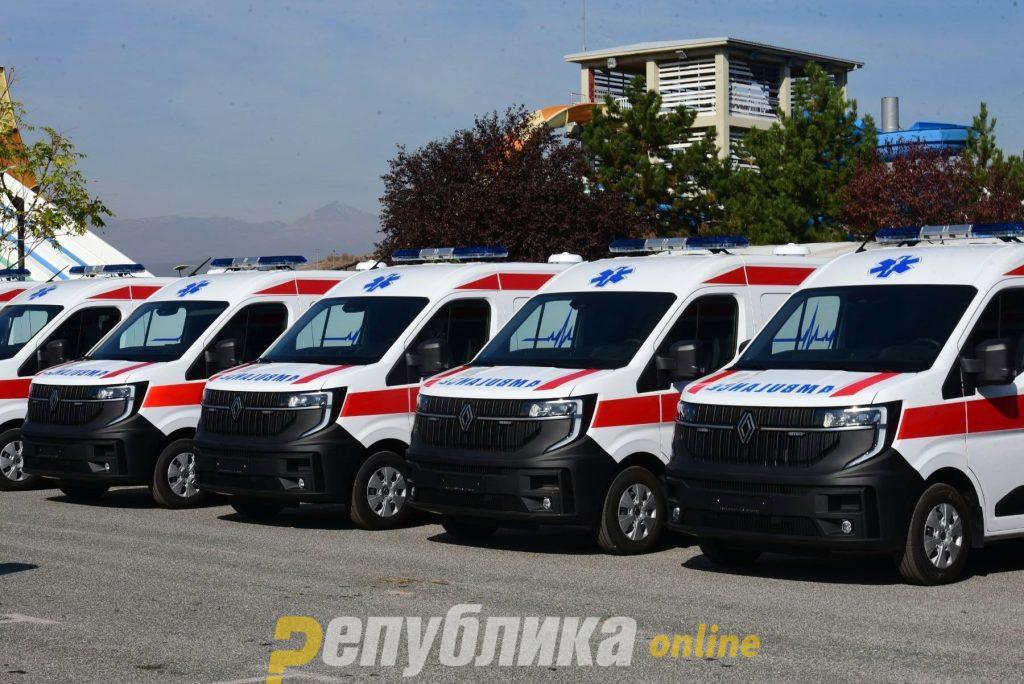
Emergency medical services across the country are receiving 100 new ambulances, with authorities currently negotiating for an additional 50 to be delivered in 2027. During the presentation held today at the parking lot of the “Boris Trajkovski” Sports Center in Skopje, Prime Minister Hristijan Mickoski expressed a wish that these vehicles be used as infrequently as possible.
“Naturally, less frequent use implies fewer cases requiring intervention via these vehicles. However, in situations where they are needed, I am confident that these vehicles will allow for faster arrival and more precise intervention, given the equipment they carry—all 100 of them,” the Prime Minister emphasized.
He also addressed the state of the healthcare sector, as well as the government’s broader policies and future plans. “Many things have been neglected, many destroyed, and many stolen. It is the task of this government to restore what has been destroyed, neglected, or stolen. There are still many problems to address—these 100 vehicles do not solve everything; while they may alleviate the situation to some extent, they are not a complete solution. Nevertheless, what is significant is that, step by step—addressing one priority and one problem at a time—we are making progress over these 27 to 28 months.” “In addition to the 120 new vehicles that the Ministry of Interior secured—following a decade of neglect in that sector—along with the hundred or so vehicles received by the national postal service, and the 53 vehicles already in use by municipalities for waste collection and cleaning, it is now the turn of these 100 ambulances,” said Mickoski.
He announced that, very soon, there will also be 150 new electric buses, which—he emphasized—will be distributed to cities throughout the country.
“All of this might not seem particularly significant or substantial at first glance. But believe me, the moment you actually need these resources—everything we are doing and providing today will prove to be immensely important—because, until now, such resources simply did not exist. I would also like to note that our priority for the coming period is investment in the healthcare sector. We will continue to invest; there is a great deal that requires investment. While we may not be able to resolve every single issue within a single government term, we have plans for the period ahead—plans currently being finalized in negotiations with our partners, specifically financial institutions. These are projects that will be jointly financed by the World Bank and the European Investment Bank.” These include the Clinical Center—specifically the Clinical Hospital in Štip, the Health Center with expanded services in Kičevo, and the Clinical Hospital in Tetovo. Following the latest mission by the World Bank and the European Investment Bank, I expect formal approval for the financing of these projects to be secured around the end of the first quarter of next year. If everything proceeds as planned, the tender will be announced immediately thereafter; and, assuming everything goes according to schedule, I expect the implementation of the first of these projects to begin sometime around the end of the second or the beginning of the third quarter of next year—the Prime Minister announced.
He pointed out that while work must continue on projects initiated 15–20 years ago, the core focus should be on envisioning the future of the healthcare sector 10–15 years from now.
Technology that existed 10–15 years ago is now obsolete; one must therefore anticipate the technological developments likely to emerge over the next 10–15 years. As we restart the project—specifically the Clinical Hospital in Štip—our focus is on technology that will remain relevant and applicable in the 2035–2040 period. “So, all of this requires proper foresight and collaboration with our strategic partners; I believe we have managed to reach a solution that will provide added value to the Macedonian healthcare system,” the Prime Minister stated firmly.
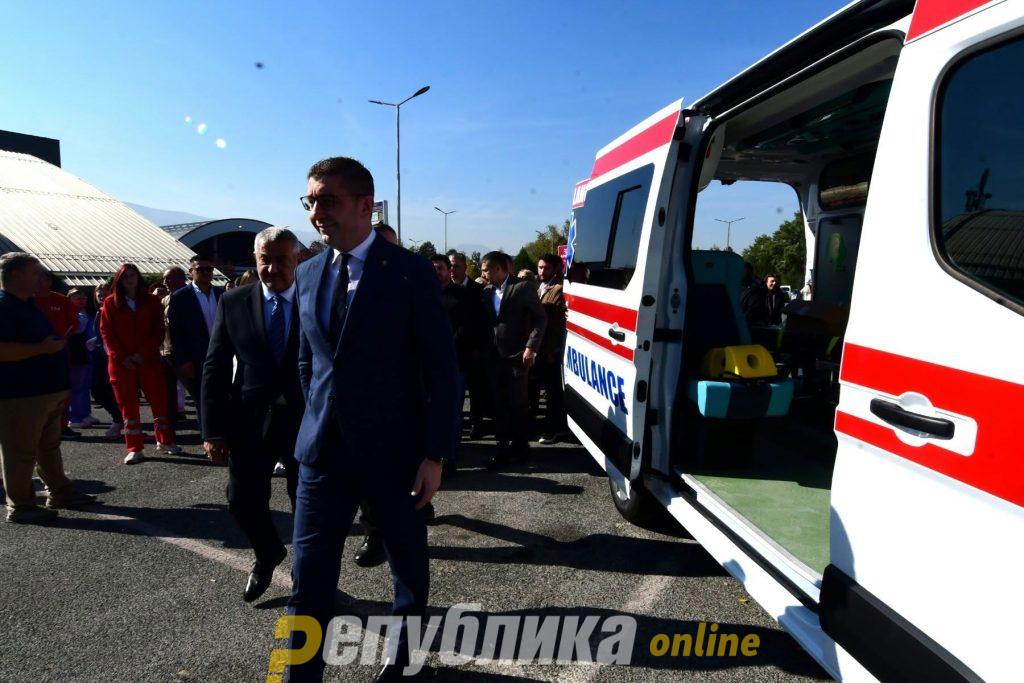
He also addressed the state of healthcare in the nation’s capital.
“We are currently situated between the two plots of land under consideration for the new clinical center. One is located in front of the Karpos swimming pool—which you can see to our left, and which had previously fallen into disrepair but is now undergoing reconstruction—while the other is situated behind the water slide you see over there. These are, roughly speaking, the two potential sites for the new clinical center. I expect that we will conclude these negotiations by the end of this year.” “We believe that this location—along with the connection to the existing ‘8th of September’ [facility], the ‘Pet Center,’ and the ‘Bucharest’ hospital (or polyclinic)—will create a wonderful symbiosis, forming a truly excellent hub. Furthermore, in collaboration with the Municipality of Karposh, we are working to secure new parking spaces; once everything is fully operational and construction is complete, congestion is inevitable. Therefore, we are planning ahead to mitigate the challenges that residents in this part of Skopje might face,” the Prime Minister explained.
The Prime Minister noted that a solid plan represents 90 percent of the work successfully completed.
“If your plan isn’t good, then the work itself won’t be either be good. That is why we are striving to ensure the plan is a good one. In any case, let us wish ourselves success with these 100 new ambulances, and may we go on to realize many more projects in the healthcare sector,” the Prime Minister stated.
He expressed his gratitude to the Minister, noting that through his dedicated work, he has seen this project through to completion and is currently developing others as well.
“I am grateful to the staff at the Ministry of Health, the members of my own cabinet, healthcare workers, and doctors—to everyone who shows such patience, as they often work under conditions that demand superhuman effort to overcome. I know how difficult it all is, yet they demonstrate that it is not impossible—that it is indeed possible to work even under such circumstances. As a government, we are striving to make things easier for them. I also thank the Members of Parliament; through their work, their amendments, and the policies they enact into law, they facilitate faster procurement and interventions within the healthcare sector. My thanks go to everyone who contributed—please forgive me if I have inadvertently left anyone out. The important thing is that we now have 100 new ambulances—something that, I dare say, has not been done for the healthcare system in Macedonia for a very long time—and I look forward to seeing another fifty added,” said Mickoski. Minister of Health Sasho Klekovski stated that Emergency Medical Services are a crucial component for improving overall healthcare in the country, particularly in saving the lives of people in urgent need of medical attention. He emphasized that, in collaboration with the Government, they have committed to taking several specific steps.
“This is the first step: the procurement of 100 vehicles, equipped to a standard far superior to what we have seen in the past. These vehicles are outfitted with ECG machines, respiratory support systems, and defibrillators; they also offer enhanced comfort, featuring climate control systems for ventilation and air conditioning. With these 100 new units, the total fleet nationwide will reach approximately 200 vehicles. Currently, we have 140 active vehicles; 60 of the new ones will be used to expand the capacity of the Emergency Medical Services, while the remainder will replace aging, worn-out vehicles,” the Minister explained.
He added that the distribution of these vehicles will be based on established criteria, including demographics, the geographical area covered by the facility, the annual number of interventions, the volume of patient transports, and the condition (age/wear) of the existing vehicles.
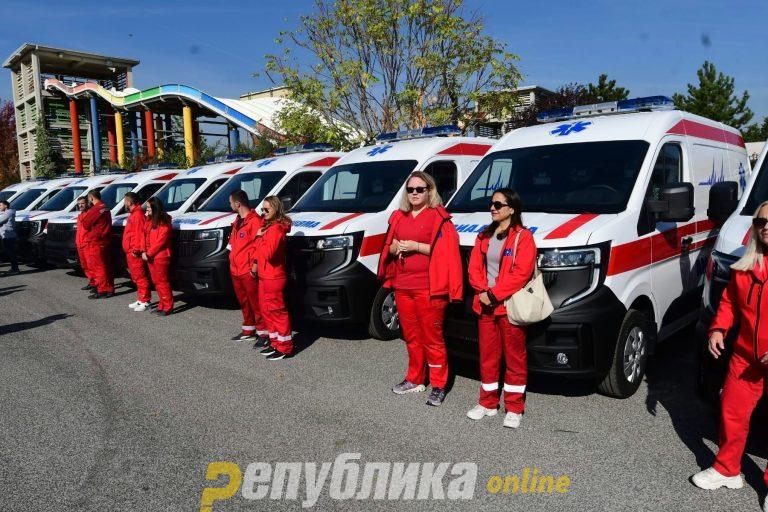
In short, an analysis has been conducted, and clear criteria for distribution have been established. “These vehicles will be put into service immediately following the necessary training for the teams on the new capabilities they offer. We are also in discussions to procure an additional 50 vehicles in 2027,” the Minister stated.
This, he emphasized, would effectively stabilize the fleet of the country’s emergency medical services for the next few years.
However, he noted that vehicles are not the only aspect of the emergency medical service that requires change.
“Essentially—and this marks a departure from previous efforts—we aim to implement broader changes and reforms within the emergency medical service. The first step is already underway: separating the emergency medical service from the Skopje Health Center to establish it as an independent entity, with the intention of extending this model nationwide. This represents a renewed focus on standards. We are currently preparing to adopt national triage standards, which will ensure a unified approach across all emergency medical services. Furthermore, we plan to eventually establish a national dispatch center to coordinate the various teams,” the Minister explained.
He pointed out that citizens are generally unaware of municipal boundaries or the specific jurisdictions of individual health centers. “And accordingly, we must respond—regardless of origin—by dispatching the team that can arrive on the scene the fastest,” the Minister pointed out.
Klekovski stated that one of the planned reforms involves the gradual introduction of paramedics into emergency medical service teams. This would free up physicians for work in emergency departments, given that the primary role of emergency medical services is to transport patients to a designated emergency center for admission.
“I welcome the establishment of the Macedonian Association for Emergency Medicine—a member of the European Society for Emergency Medicine—from which we expect guidance and support regarding the reforms we are planning. The goal is to have a functional, effective emergency medical service that can reach the site of an incident as quickly as possible and ensure the safe transport of patients,” Klekovski emphasized.
When asked about the shortage of healthcare personnel in the country, Klekovski noted that the most critical shortage is among drivers.
“We have a comprehensive, category-based analysis of personnel at the national level—covering drivers, physicians, and nurses—including projections for retirements up to 2030 and an identification of potential bottlenecks. Currently, the shortage of drivers is the most critical bottleneck of all. Based on these analyses, prepared by the Ministry of Health, we will engage with the relevant health relevant institutions and the Ministry of Finance for obtaining approvals – he replied to a journalist’s question.