
 English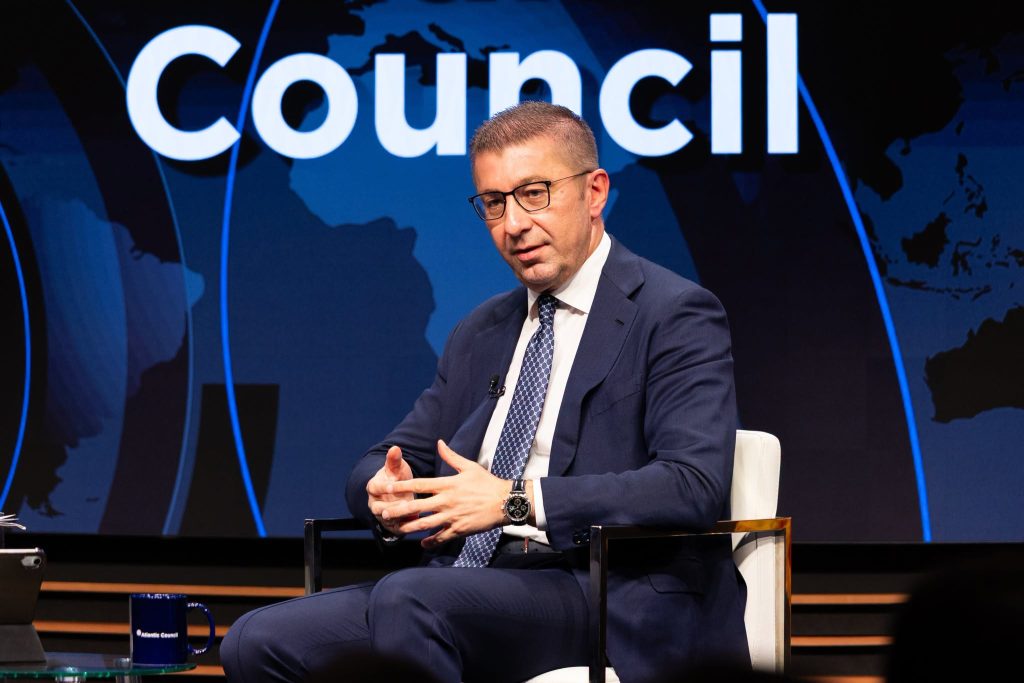
The EU accession process should be merit-based, but in our case—sadly, yet truly—it is nowhere near that, said Prime Minister Hristijan Mickoski in his remarks at the Atlantic Council on Thursday. He adds that on this journey, Macedonia faces and grapples with so-called bilateral issues and cannot move forward, even though—as he puts it—it delivers on everything required for a merit-based EU accession process. According to him, the previous government, lacking domestic results and seeking to cling to power, agreed to yet another constitutional amendment—something it could not deliver on—thereby placing the country in a difficult position regarding EU membership. However, the Prime Minister emphasizes that the current government is striving to overcome this while simultaneously working on the country’s development.
“Unfortunately, we deliver on everything regarding the merit-based accession process, yet we constantly face artificially imposed obstacles. First, it was the change of our constitutional name—there is no need for me to remind you what happened back then. Now, we face an additional condition: another amendment to our Constitution. What worries me even more is the fact that this process practically never ends. No one can guarantee that this is the last one. Ours is a unique case,” says Mickoski. He emphasizes that our case bears no resemblance to the experience of previous countries that joined the EU, as we initiated the process even before Croatia—signing the Stabilization and Association Agreement over 25 years ago.
We became candidate countries alongside them. We received the first positive report from the European Commission recommending the start of negotiations at the same time they did. Unfortunately, we have been unable to begin since then due to certain artificial obstacles. We need to work together with the EU, the Macedonian Prime Minister stressed.
He added that Macedonia is in the same position it was 26 years ago. “It is sad but true, and highly frustrating and disappointing for the citizens of my country. Despite the fact that they have done more than anyone else for the sake of European integration and enlargement, we remain—unfortunately—in the hallway, or rather the cloakroom; we aren’t even in the hallway yet, just waiting for a window of opportunity to open,” he says.
Regarding the messages from European Council President Antоnio Costa—urging the implementation of the 2022 agreement with the 27 EU member states (which entails approving the constitutional amendments demanded by Bulgaria) and stating there is no “Plan B”—Macedonia maintains that the previous government, having failed to deliver results domestically, agreed to anything just to stay in power. The previous government failed to deliver results at home and essentially said: “Here, give us a blank sheet of paper, and we will accept anything.” And that is exactly what they did. They committed to amending the Constitution, despite the fact that theirs was a very weak government lacking a two-thirds majority in Parliament. We were in the opposition at the time and warned them against accepting this, because by agreeing to that blank sheet of paper, they would derail my country’s EU enlargement process. Unfortunately, they lacked the foresight and accepted everything, says Mickoski.
Among the conditions there is once again a demand for a further constitutional amendment. Our Preamble contains a sentence stating that Macedonia is the country of the Macedonian people and of the Albanians, Serbs, Turks, Vlachs, Roma, Bosniaks… Our eastern neighbor demanded an addition—”Bulgarians and others.” Currently, the Preamble ends with “Bosniaks and others.” This is quite peculiar, given that the category of “others” encompasses all citizens of my country, including the Bulgarian community. Yet, we are talking about a community that, according to the latest census data, numbers approximately 3,000 people. We are not talking about 300,000, 3 million, or 300 million—we are talking about 3,000 citizens. Why should we do that? We are talking about human rights. If we are discussing human rights: we are politicians, not human rights experts. As politicians, we risk merely exploiting this issue. There is an institution in Europe responsible for adjudicating whether or not someone’s human rights have been violated. That institution is the Court of Human Rights in Strasbourg and the Council of Europe. A few months ago, the Council of Europe stated: we are ending the post-monitoring and monitoring mission for my homeland because all democratic standards have been met, the Macedonian Prime Minister explained.
He also noted that in the last few years, the Court in Strasbourg has ruled in favor of the Macedonian community in Bulgaria 14 times—finding that the human rights of the Macedonian community living in Bulgaria were violated by Bulgarian authorities—whereas, as he put it, there have been zero such rulings regarding the Bulgarian community in my country.
We have a score of 14 to zero in favor of the Macedonian community in Bulgaria compared to the Bulgarian community in my country. How can we explain and justify that this demand is part of a merit-based approach? Since we are talking about merits—what is the connection between merits and the demands of the local community? The answer is no, I can understand the EU rule based on unanimity. It is a matter of principle, and presumably, all member states will be unanimous and convey the same message. However, considering that in the past we changed our flag, our constitutional name, and the Constitution itself several times—and the message was always, “Do this, and this is the last step; there will be no further obstacles”—we complied. Yet, unfortunately, we are back at square one, the Prime Minister stated emphatically.