
 English
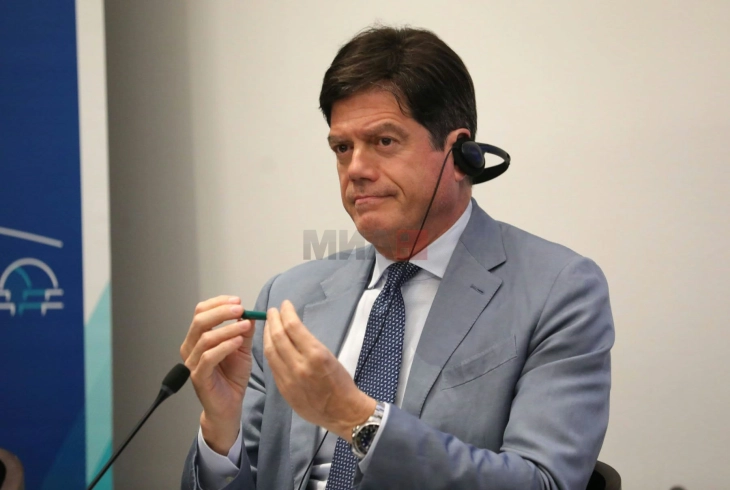
The European Union is allocating funds to strengthen the country’s military capabilities and security, while also supporting its road, rail, energy, and digital connectivity through various financial instruments, stated EU Ambassador Michalis Rokas. He emphasized the EU’s strong commitment to seeing Macedonia become a member of the Union as soon as possible, noting that regional connectivity and the strengthening of resilience are particularly important in the current geopolitical reality.
Speaking at a panel discussion titled “Strategic Connectivity for Stability: The EU and Macedonia in the New Geopolitical Reality,” Rokas pointed out that nearly 65 million euros have been allocated to the country through the European Peace Facility, with an additional 40 million euros expected to be secured soon to bolster the nation’s military capabilities.
“That is why we also wish to provide a response in the sphere of security. Precisely for this reason, we have allocated nearly 65 million euros for Macedonia through the European Peace Facility. We hope to soon secure an additional 40 million euros to strengthen the country’s military capabilities and—given its status as a NATO member—to enhance our collective security,” said Rokas. He emphasized that the response of the European Union and the Government to current challenges is comprehensive, as connectivity, economic stability, and security are interdependent.
“As you can see, our response—that is, the response of the European Union member states and the Government here—is comprehensive. We are attempting to view all these issues through the same lens,” the EU Ambassador noted.
Regarding infrastructural connectivity, Rokas pointed out that the EU has been providing support since 2007 through various financial instruments. He noted that 1.2 billion euros have been allocated via the Instrument for Pre-accession Assistance, an additional 1.8 billion euros through the Western Balkans Investment Framework, and 750 million euros through the EU Growth Plan—which is being implemented in Macedonia via the Reform Agenda.
He clarified that this support extends beyond road and rail infrastructure to include energy and digital connectivity, as well as other activities—such as the technical assistance required for the realization of these projects. As one of the reasons for investments in connectivity, Rokas pointed to the EU’s commitment to the country’s European integration, as well as the fact that disruptions to value chains have consequences for the wider region and for the Union itself.
“We are strongly committed to Macedonia becoming a member of the European Union as soon as possible. However, this also affects us and is of great importance to us. It is not merely a matter of two vital corridors—Corridor 10 and Corridor 8—intersecting just a short distance from Skopje. It is also because we are aware that, today, we have interconnected value chains; if even a small part of one is disrupted, it affects us all,” the EU Ambassador emphasized.