


 English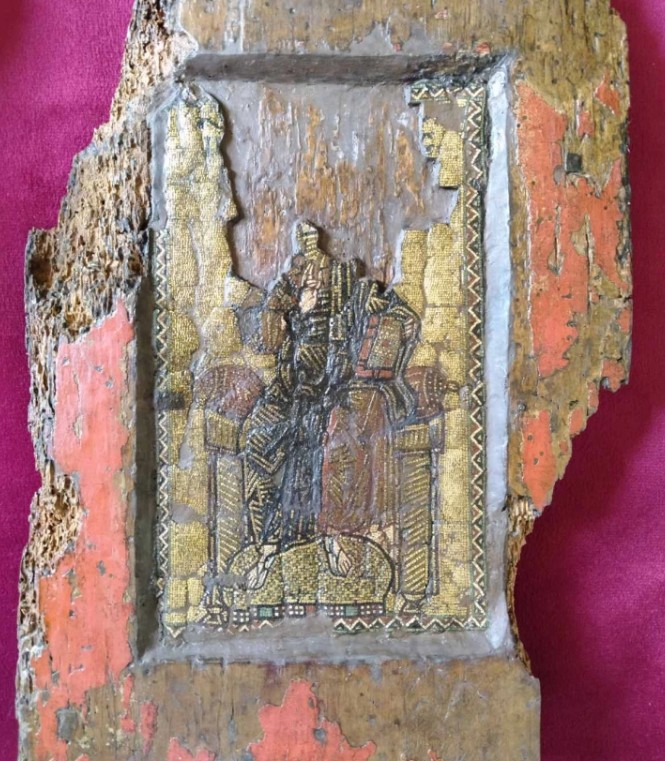
The only preserved portable mosaic icon from the Byzantine era in Macedonia – “Jesus Christ on the Throne” from the 14th century – was presented to the public for the first time today at the Gallery of Icons in Ohrid, as part of the celebration of the 75th anniversary of the founding of the Ohrid Museum and the commemoration of the 1110th anniversary of the repose of Saint Clement of Ohrid.
In front of those present, curator Katerina Velkoska emphasized that this is an exceptionally rare monument of Byzantine art, which belongs to the small group of portable mosaic icons preserved in the world.
This is the only preserved mosaic icon of this type in Macedonia and belongs to the rare category of portable Byzantine mosaic icons, Velkoska emphasized, pointing out that the production of such works required top technical knowledge, exceptional precision and the use of expensive materials, which is why they were available only to the highest strata of Byzantine society.
She explained that the peculiarity of the mosaic technique lies in the way in which the small mosaic cubes refract and reflect light, especially the golden segments, creating the impression that the light emanates from the representation itself.
The image is not only represented, but also ‘shines’ through the material from which it is created, Velkoska emphasized, adding that this is precisely what makes the mosaic icon a unique artistic and spiritual testimony.
The icon dates back to the 14th century, the period of the Paleologus Renaissance, when Ohrid was one of the most significant spiritual and cultural centers of the Orthodox world. According to Velkoska, the work should be seen precisely in that context, as a testimony to the high level of artistic ties between medieval Ohrid and Constantinople, Solun and other regional centers.
It was particularly emphasized that such portable Byzantine mosaic icons are today kept only in the world’s most important museum collections, including the Louvre in Paris, the Metropolitan Museum in New York, the Bode Museum in Berlin and the Byzantine and Christian Museum in Athens, which further confirms the value of the Ohrid specimen.