
 English
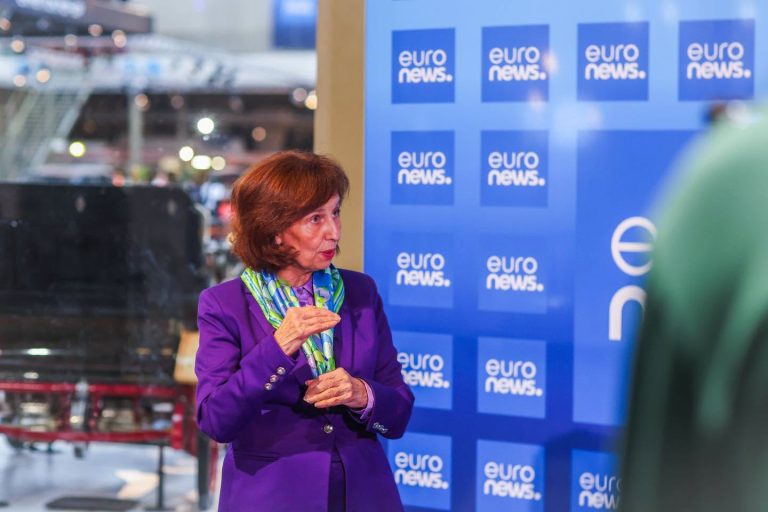
President Gordana Siljanovska-Davkova believes that the European Union should demonstrate political will and offer solutions to unblock the country’s European integration process, rather than continuing to insist on the fulfillment of the latest demand for constitutional amendments. Speaking from the Enlargement Summit in Brussels, the President stated that the country is prepared to negotiate; however, she expects the EU to also take the initiative—including by defining guarantees regarding the conditions under which the process will proceed.
In an appearance on the Sitel TV, Siljanovska-Davkova emphasized that Macedonia deserves to be among the frontrunners in the enlargement process, underscoring the state’s firm commitment to its European path. She noted, however, that following multiple constitutional amendments and persistent demands for Macedonia to demonstrate political will, it is now necessary for the European Union to also show a readiness to find a solution with Bulgaria.
“We are likely the country that has been urged and encouraged the most times to demonstrate political will in order to accept this latest ‘condition’—or, rather, this latest demand. I wanted to convey the message that the European Union, too, needs to demonstrate political will. I believe that we belong among the frontrunners.” “When it chooses to, the European Union can be very creative and demonstrate such political will,” said Siljanovska-Davkova.
She noted that the Union should encourage the country not only in the implementation of reforms but also in finding a solution with Bulgaria. Siljanovska-Davkova assessed that Macedonia finds itself in a paradoxical situation: on one hand, it receives messages from Bulgaria stating that the issue is a European one, while on the other, the EU points to the need for dialogue and negotiations.
According to her, there are various ways to overcome the blockade—including the proposal for “delayed effect”—as well as the possibility for the European Council and the Council of Europe, in consultation with the European Commission, to draft explanatory provisions regarding the Union’s principles and obligations.
“We want to know under what conditions things will proceed. It is possible to draft explanatory provisions that address the issues of greatest importance to the European Union—such as the meaning of equality, solidarity, a good-faith approach, and the EU’s obligation to respect constitutional and political structures, as well as cultural and national identity,” said Siljanovska-Davkova. She emphasized the importance of continuing reforms in parallel with political efforts to overcome the bilateral dispute, noting that the country should capitalize on the current momentum for reform implementation rather than expending energy on issues that are difficult to resolve independently.
Regarding the upcoming European Commission progress report on the country, Siljanovska-Davkova stated that she had not yet seen the document, but noted that its findings, assessments, and recommendations would be crucial for evaluating progress made and identifying areas requiring further action.
She highlighted the rule of law, the fight against corruption, and the functioning of institutions as areas where the country has historically faced weaknesses. She added that the process of “Europeanization” should focus on fostering a functional democracy, independent institutions, economic development, and an improved quality of life for citizens.
Drawing a parallel to the case of Montenegro—and the issues it must resolve with Croatia during its own EU accession process—Siljanovska-Davkova distinguished between different approaches to settling bilateral disputes. She welcomed the stance taken by Croatian Prime Minister Andrej Plenković, who suggested there is still room to resolve outstanding issues by 2028, noting that negotiations require two parties and a mutual willingness to engage in dialogue. The very fact that Mr. Plenković states the problem will be resolved by 2028 opens up space for a solution. We all know that this is the right approach. We do have some reservations, but we will resolve them together. As for us, I have not heard any such prompting or encouragement… It is logical, 13 years after Croatia’s accession to the European Union, to see the doors opening for the Balkans. In that sense, I am, of course, also pleased with Montenegro’s progress – said Siljanovska-Davkova.