


 English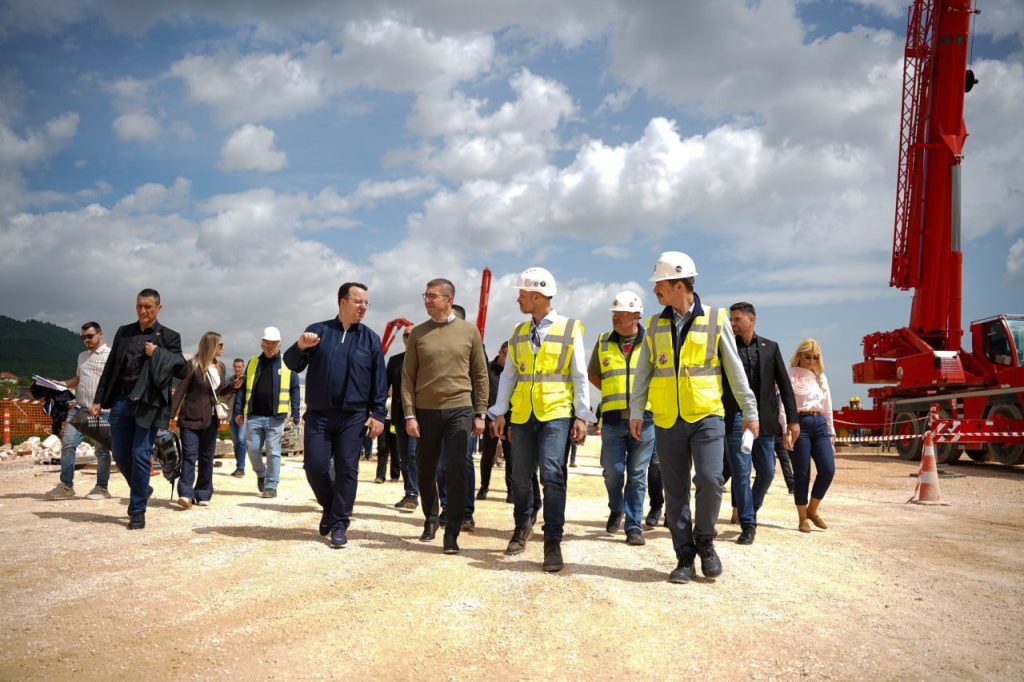
The Government plans a cycle of 10 billion EUR investments in infrastructure projects, said Prime Minister Hristijan Mickoski during a press briefing today. This includes the on-going construction on half a dozen highways – six sites will be active in the second half of the year.
Mickoski said that the long delayed Kicevo – Ohrid highway will be made operational in September or October, likely in time for Independence Day – September 8th, while the highway will be fully open for the public in the first quarter of 2027. The final work was financed by a consortium of domestic banks, and the loan agreement with the Chinese Ex-Im bank was broken off.
An appeal process is on-going for the planned Skopje – Blace highway that will link Macedonia to Kosovo, and will be worth 215 million EUR. Work is expected to begin as early as this month.
On the Bechtel-Enka project, the company is working on three highways simultaneously – Tetovo-Gostivar, Gostivar-Bukojcani (Kicevo) and Prilep – Bitola. The first 11.5 kilometers of the Bitola – Prilep highway will be open for use in September 2027, the Prime Minister said, and the intention is that 250 million EUR will go toward the Bechtel projects every year, for the next there years.
In terms of railway infrastructure, the key projects are the modernization and construction of the railway on Corridor 10, for which the Prime Minister announced that the work on the ground will be completed by the end of the year at the latest, and finishing Corridor 8, the construction of the railway to Bulgaria, the sections Kumanovo – Kriva Palanka, whose construction is underway, as well as Kriva Palanka – the border with Bulgaria, with the cross-border railway tunnel, there is still no work on the ground. Also, the modernization of the Skopje – Kichevo railway on Corridor 8.
The good news, Mickoski said, is that the tunnels on the section between Romanovce and Kriva Palanka are already finished in terms of the groundwork, and engineers have also come up with an economical solution to put into use the decades old concrete pillars built when the project was initiated in the 1990ies. Mickoski urged for more work on the part of Bulgaria to begin construction of the tunnel that will connect the two countries.