
 English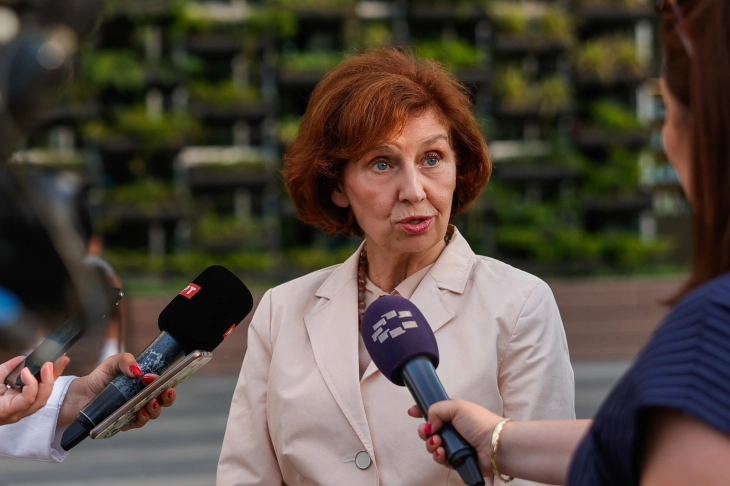
President Gordana Siljanovska – Davkova, who met with her Bulgarian counterpart Iliana Yotova in Sofia today, said that it is clear that Bulgaria will have additional demands, linked to Macedonia’s history, besides its current request for constitutional changes.
I wanted, with my colleague Mucunski, to hear their positions, so that we can give chance to negotiations, to the conservation and to dialogue. I can only say what is clear to both of us: it is not just the constitutional amendments, but there are other requests linked to the protocols and the work of the historic commission. That is all I can say for the time being, said President Siljanovska.
The President added that our delegation raised issues such as Bulgaria’s refusal to follow up on the verdicts of the European Court of Human Rights regarding the organizations of ethnic Macedonians in Bulgaria.
On her side, President Yotova said that Macedonia must meet the demand and include the Bulgarian minority in its Constitution. In a statement, her office said that she will stand up for the rights of Bulgarians in Macedonia and raised the case of an dual citizen woman who was involved in a traffic accident in Macedonia and had both her passports seized to prevent her leaving the country during the course of the investigation.
The Bulgarian press swamped President Siljanovska after the official press conference at the Balkan summmit she attended. Responding in English, President Siljanovska said that she is not a monarch to meet the Bulgarian requests, but that she supports full respect for human rights, which is not the case in Bulgaria. Afterwards, Siljanovska said that she regrets the style of the questioning, given that the journalists did not wait for each other to finish asking a question and were speaking over each other.
In his remarks, Foreign Minister Mucunski said that Macedonia must be assured that there will be no additional demands linked to the history, identity and the language, or issues related to the historic commission. “These are the biggest misunderstandings. Strong identities do not have the need to build themselves up by attacking other identities. In Europe in the 21st century we should be prepared to celebrate our differences, said Mucunski.