

 English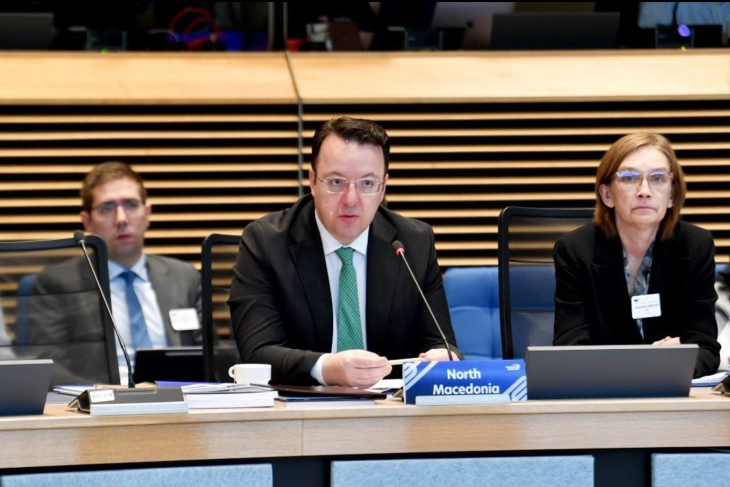
We are putting in strong efforts to build and modernize the two European corridors that pass through the country, through the railway connection with Bulgaria, the construction of a high-speed railway on Corridor 10 and the construction of highway sections on Corridor 8, said Deputy Prime Minister and Transportation Minister Aleksandar Nikoloski during the ministerial council of the Transport Community, which is being held today in Brussels. Nikoloski announced the signing of a declaration for construction of a fast railway line that will be signed by Macedonia, Greece, Serbia, Hungary and Austria.
We are lucky that two pan-European corridors, 8 and 10, pass through our country and we have decided as a government to make efforts for the progress of both corridors. This is something that we are working on together with our friends and partners, Nikoloski said. He recalled that last month an agreement was signed with Bulgaria for a direct railway connection between the capitals Skopje and Sofia via Corridor 8.
This is a great achievement for both countries. Something that will completely change the reality in the region and we are now working to implement it. For our part, the railway is divided into three sections. One has been in operation since January this year, the second I hope to complete next year, and for the third we are working with our partners from the EIB to announce the tender no later than January and I expect progress there and that way we will reach a connection with Bulgaria through a tunnel, Nikoloski stressed.
When it comes to Corridor 10, Nikoloski stressed that in the railway sector, the country has decided to build a high-speed railway with a speed of up to 200 kilometers per hour for passenger trains and 120 kilometers per hour for freight trains, for which favorable financing has been provided by the United Kingdom and preparatory work is already underway.
If all goes well, I expect the first machines to be on the ground no later than June 2026 and to be completed within a period of five years. That will be a great boost for the economy in the region and for connectivity, added the Deputy Prime Minister.
Nikoloski also informed that the procedure for the Corridor 10 highways is also underway, which is being worked on with the World Bank, and work is also underway on the highway solutions for Corridor 8.
The Ministerial Council, which is being held under the organization of the Secretariat of the Transport Community, is discussing the progress of the Western Balkan countries in the area of transport policy and the implementation of infrastructure projects.
The meeting, chaired by the European Commissioner for Sustainable Transport and Tourism Apostolis Tsitsikostas, is attended by, in addition to Nikoloski, ministers of transport and government representatives from several European countries, including Albania, Bulgaria, Ireland, Cyprus, Kosovo, Romania, Slovenia, Serbia and Montenegro.
With the participation of the Council of Ministers, Nikoloski concludes his working visit to Brussels, during which he yesterday addressed the panel “Enlargement Issues: Europe’s New Geopolitical, Security and Economic Frontier” within the framework of the “EU-Western Balkans Summit”, organized by the think tank “Friends of Europe”, and also had several bilateral meetings with his colleagues and representatives of the EU and the Transport Community.