

 English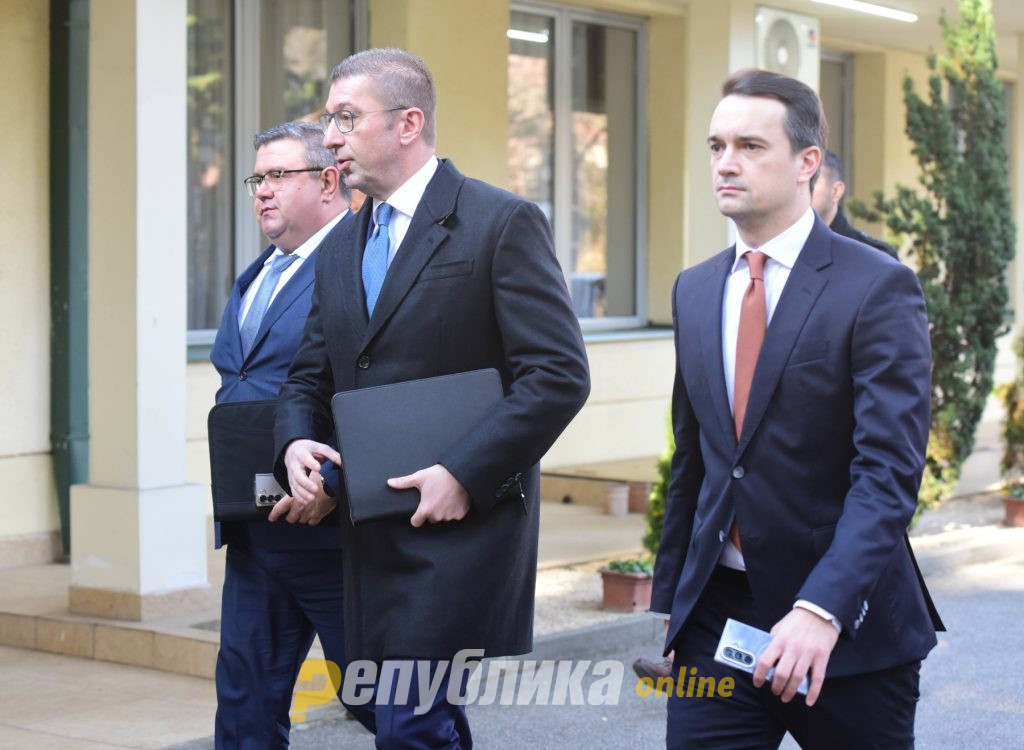
A successful and productive meeting – this is the overall conclusion after leaders of the main parties met today to discuss a number of joint priorities, such as the electoral code and the EU reform agenda. Prime Minister and VMRO-DPMNE leader Hristijan Mickoski convened the meeting, and opposition leaders Dimitar Apasiev from Levica and Ali Ahmeti from DUI attended, along with representatives from ruling majority coalition partners VLEN and ZNAM. Only notable abstention was SDSM leader Venko Filipce.
Many of the open issues were raised. For some of them, would say for the majority of them, we have the same opinions and a common language, and in some, as is normal, our positions differ. But what is very important for me, is that, through such a discussion, all the participants in the meeting publicly said that it was a construction meeting. As organizer and President of the Government, I’m glad that the Macedonian public, in this time of holidays, was able to see a different behavior from the political parties, a mature, constructive approach that means that we are overcoming the issues and not creating problems, Prime Minister Mickoski said.
On one of the open issues – ending the model of technical governments that are created before general elections, Mickoski said that all parties present agreed that it is a dated model and should be overcome. But since SDSM, who will be the main beneficiaries of this model in the next general elections, stringently oppose ending it, Mickoski said that he will not insist on changes for the next general elections, but only after for the elections after that. This means that the vote to end this model would take place soon, but that SDSM, as the narrowly largest opposition party, would still get to appoint its representatives in the technical government that will prepare the next general elections, and after that this rule will be abolished.
Other electoral issues that were raised, such as restoring the vote of the diaspora, that was initiated by the VLEN party. Mickoski said that before this issue is resolved, the parties should agree whether to abolish the current six electoral districts and institute a single district. This would simplify the counting of the votes from Macedonian citizens living abroad, who would still face issues in some countries that don’t allow the opening of polling stations outside of the diplomatic missions.
Levica, usually the most harshly spoken party in the Macedonian political scene, welcomed the outcome of the meeting that included some of their priorities – mainly instituting a single electoral district that will help smaller parties win seats without needing to form a coalition with larger parties. Levica proposed that the dispute over the appointment of the next Ombudsperson, who is elected with a larger majority that the ruling coalition currently does not have, is resolved in a way that a compromise figure – an ethnic Roma – is appointed. According to Levica, this can help reduce the systemic discrimination of the Roma community.
Ali Ahmeti and DUI are expected to make some concessions on one technical issue – the legal changes needed to start implementation of the Safe City camera system which requires a two-thirds majority. The system is operational and is issuing warnings to the citizens, but to make them into official fines, changes to the law on misdemeanors are needed. Prime Minister Mickoski said that all laws that are part of the reform package and that have been evaluated positively by the European Commission and the Venice Commission should be supported by all parties – without conditions.
DUI leader Ali Ahmeti spoke after the meeting of party leaders and said that his party supports the creation of a single electoral district, that is expected to reduce the disproportionate effect of the majority Albnaina 6th electoral district. But, Ahmeti insisted that the electoral model includes a high threshold of 5 percent for the smaller parties to win seats, that would largely negate the effect of instituting a single district – and that the parties submit open lists allowing the citizens to choose individual candidates.
Regarding the issue of ending the technical government model – which the ruling coalition can abolish on its own, Ahmeti said that additional consultations are needed with the EU and the US. Ahmeti also said that more consultations are needed on the election of the next Ombudsperson. Ahmeti added that he discussed holding a separate meeting with Prime Minister Mickoski. Mickoski responded that he has meetings with all relevant political factors in the country.