


 English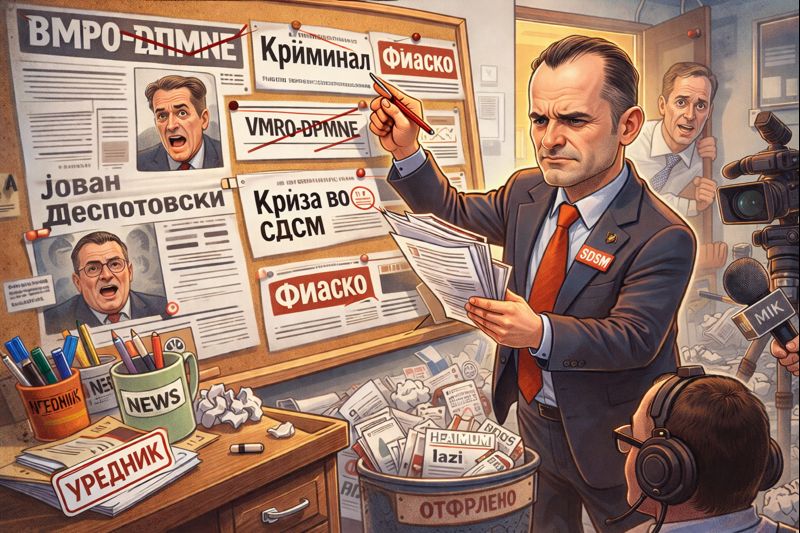
SDSM leader Venko Filipce continued its campaign of accussations against news outlets who bring up the significant corruption allegations from his time in power, as Healthcare Minister in the Zaev regime. In a press conference, Filipce presented headlines from news sites that cite the allegations about him – including from Republika – and tried totportray himself as a victim because the media have raised these questions about him.
Republika responded with the following position:
If anyone is still wondering where the opposition is today, the answer is clear: in the media offices. More precisely – in their editorial desks.
Lately, the SDSM leader Venko Filipce has not been acting as a classic opposition politician, but as something between an editor-in-chief, a media commentator and a guardian of our front pages. The man does not talk about policies – he proofreads and editorializes.
Instead of “what does SDSM offer”, we get “why did you use this titlein your article?”. Instead of an alternative to the government – we get alternative fonts, punctuation and intonation. If this continues, the next logical step would be a press conference on why a comma is in the wrong place and the question mark is too aggressive.
It seems that Filipce has come up with a new political genre: opposition through headlines. If the headline is soft – that’s democracy. If it is hard-hitting – it’s been planned. If it is critical – we are a media octopus. If it quotes VMRO-DPMNE – it’s media lynching. If it quotes a former SDSM party member – they are fifth columnists. If it doesn’t mention Filipce at all – conspiracy by silence.
By this logic, the media don’t report – they participate in politics. Journalists don’t ask questions – they coordinate. And headlines are not headlines – they are weapons. One gets the impression that there is no editorial policy in Macedonia, but only a central bureau that dictates what can and can’t be published. Except that, according to Filipce, that central bureau can by anywhere – except in his party headquarters in Bihacka street.
The most comical thing is that this entire fight is being waged in the name of freedom of expression. A politician holding a press conference to complain that journalists shouldn’t have written the way they did tells us that this is what the fight for democracy looks like. A bit like a firefighter putting out a fire with gasoline, but convinced that he is working according to European standards.
And while the public expects the opposition to discuss with prices, salaries, security or state institutions, it seems that its leader is busy counting the headlines and puts them in piles: this one is toxic, this one is even more toxic, this one is definitely from a “media octopus”. Soon we will get a scoreboard – which media outlet has been “against” him how many times.
In the end, one simple question remains: if the leader of the opposition has so much time on his hands and energy to deal with headlines, does that mean that everything is fine in our politics? Or maybe headlines are a problem because they say the loudest what politicians quietly avoids?
In any case, one thing is clear: while the government rules, the opposition regulates.
And our democracy… it waits for someone to write a good headline for it.