


 English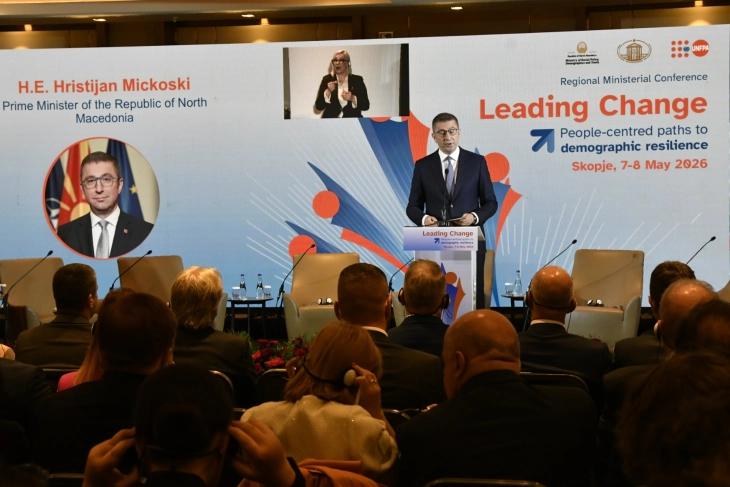
A conference on the demographic changes in the region was held in Skopje today, to address the collapsing birth rates and discuss ways toward demographic resilience.
This is not just another conference, this is a conversation about the future of our peoples, about what kind of countries we will leave behind, whether we will create societies in which young people will want to stay, families will want to create a future, and the elderly will live with dignity, Prime Minister Hristijan Mickoski said at the opening of the event.
The Prime Minister emphasized that the demographic crisis already has visible consequences and that it must not be treated exclusively as a matter of statistics. He assessed that the previous approach, focused mainly on numbers, has created policies without a long-term vision and real impact.
For a long time, many countries, including in our region, viewed these changes exclusively through the prism of numbers – how few of us there are, how much we are aging, how many people are leaving. This so-called demographic anxiety often created policies that reacted late, fragmentedly and without a long-term vision. But the essence is not only in the numbers. The essence is in the quality of life, in the trust that citizens have in their own country, in the feeling that they can create a home, family, career and future here, emphasized the Prime Minister.
The Minister of Social Policy, Demography and Youth, Fatmir Limani, also addressed the conference, assessing that the region and Eastern Europe are facing deep and long-term demographic challenges.
The region and a large part of Europe, especially Eastern Europe, are facing serious demographic challenges, low fertility, migration and accelerated population aging. In some countries, the population has decreased by a third since the 1990s, with direct consequences for the labor market, health and pension systems and economic competitiveness – Limani emphasized.
Foreign Minister Timco Mucunski pointed out that human capital of the Macedonian diaspora represents a key strategic resource for the development and international position of the country.
Our diaspora represents a huge potential and a natural bridge between countries in the world, connecting people, economies, knowledge and new opportunities. Therefore, through the new Strategy for Cooperation with the Diaspora 2025–2030, we want to build stronger and more dynamic ties and go beyond the framework of traditional remittances towards long-term investment and development partnerships, said the minister.
Referring to the retention of young people, Mucunski said that this requires specific policies and economic transformation, with real opportunities, quality jobs and a competitive economy. “Through integration into the European Economic Area and the European Union’s Growth Plan, we create mobility that is a choice, not a necessity, and conditions for building the future at home”, Mucunski said.