

 English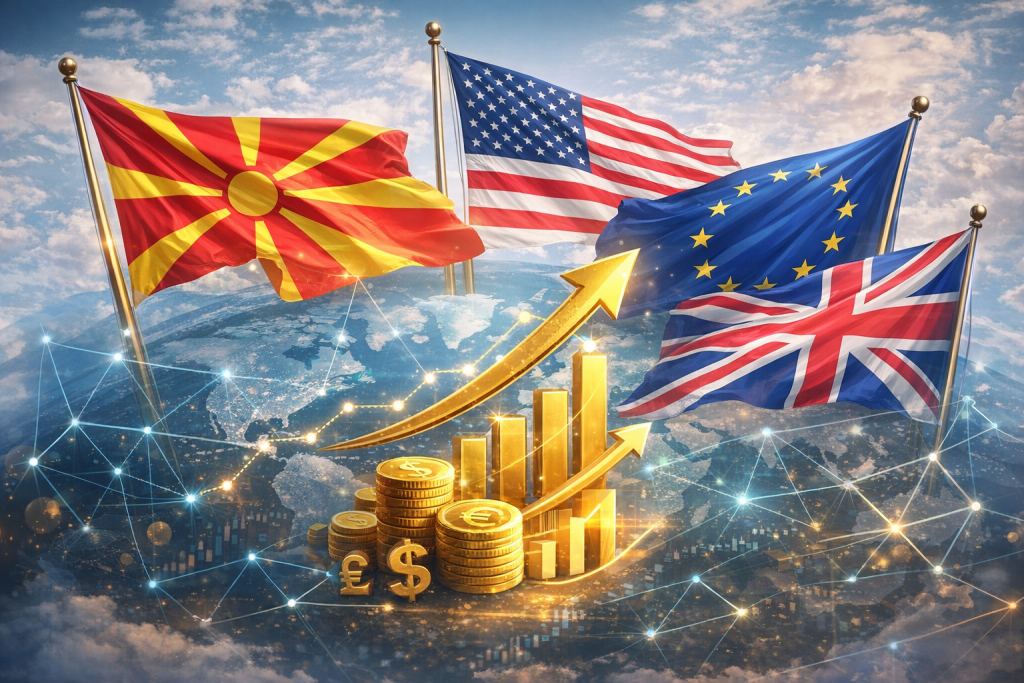
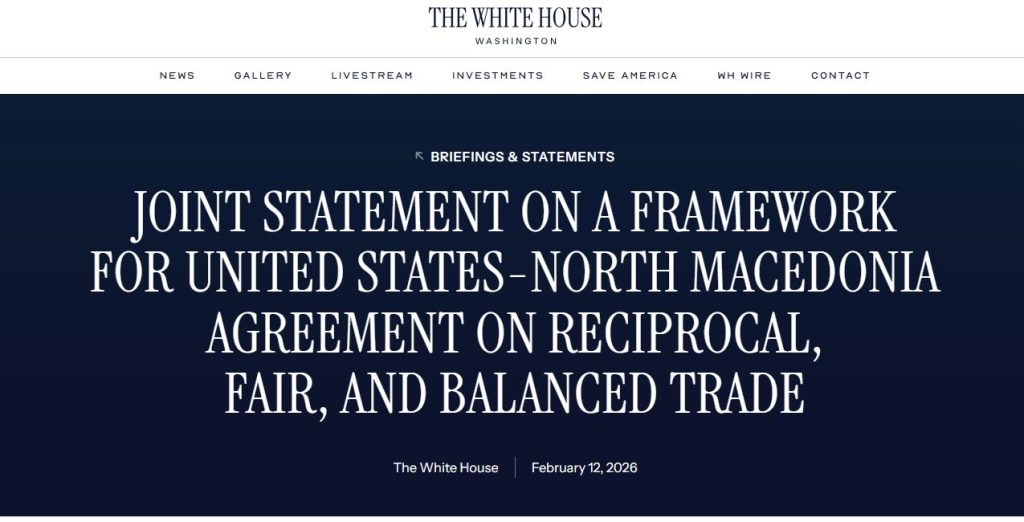
The United States and Macedonia issued a joint statement for an agreement on reciprocal trade, that will set tariffs to Macedonian exports to the United States at a maximum of 15 percent, with some products to be sold with no tariffs. Macedonia will remove its own tariffs for US products.
We are deepening our ties with a key partner in the Balkan region and unlocking new opportunities for American workers and businesses, said US Trade Representative Jamieson Greer.
This announcement, that removes any lingering uncertainty about Macedonia’s position in the new US international trade order, and comes after several other major international events for our country, and sends a clear political and economic message: Macedonia is positioning itself as a stable partner in the trans-Atlantic economic architecture and is gradually completing the process of institutional and market integration with Western allies. These include the partnership agreement with the United Kingdom, as well as the ending of the 26 years long post-monitoring dialogue by the Council of Europe.
The announced trade framework with the US foresees tariffs that will not be higher than 15 percent, and for certain products and industries a zero rate will also be applied. For the Macedonian economy, this means greater predictability in access to the US market, but also opening up space for new export sectors, especially in industries with higher added value. In the face of global supply chain disruptions, such agreements are not just classic trade instruments, but mechanisms for long-term economic positioning. They make the country part of broader networks of trusted partners, which is especially important for small and open economies like Macedonia.
Earlier this month, the closure of the post-monitoring dialogue in the Council of Europe, after more than two and a half decades, was a signal that institutional development is entering a new phase. In parallel, the agreement with the United Kingdom has strengthened bilateral economic cooperation with one of the key European markets.
Now, with the American initiative for reciprocal trade, the triangle of cooperation is being completed: Europe – United Kingdom – United States. It is a framework that brings not only political support, but also concrete economic opportunities – from investments and technology transfer to greater integration into global production flows.
The joint statement pays special attention to energy cooperation, including connection to the regional gas infrastructure and the possibility of diversifying energy supplies. This is an important step towards reducing dependencies and strengthening energy security — an issue that has become central to the European economy in recent years.
In parallel, the emphasis on digital trade, protection of intellectual property and facilitation of trade in services indicates that future cooperation will not be based only on the classic exchange of goods, but also on knowledge, technologies and innovations.
The combination of institutional completion of long-standing international processes and the opening of new economic agreements sends a strong signal to foreign investors: Macedonia is moving towards a stable, predictable and partnership-oriented business environment.
For a country with an export-oriented economy, such agreements mean easier access to markets, greater competitiveness of domestic companies and the opportunity to be included in new production and logistics chains. The announced agreement with the US is not an isolated move, but part of a broader strategy to deepen economic ties with traditional partners. At a time of global economic redefinitions, positioning Macedonia among the countries with which “reciprocal, fair and balanced” trade relations are being built is an important step forward. The next period will be crucial for finalizing the agreement and turning it into concrete economic results, but the direction is already clear — gradual integration of the Macedonian economy into the broader transatlantic economic space.