


 English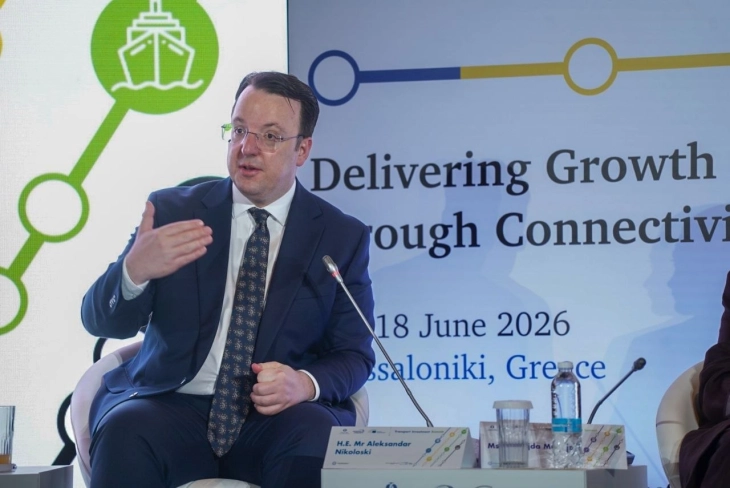
Deputy Prime Minister Aleksandar Nikoloski attended a summit in Solun (Thessaloniki) today to discuss development of the north-south Corridor 10. Nikoloski emphasized that Corridor 10 is the most important economic corridor in Europe. The summit, he assessed, is a message that Corridor 10 will be built by all the countries to which it belongs and will become the most important economy in Europe.
We are starting the construction of the high-speed railway on the Macedonian part of Corridor 10 – a project that will change the reality in the region for both passenger and freight transport. It connects Europe completely from the port of Piraeus in Athens to Helsinki in Finland, and if we use it wisely, we can completely change the economy in Southeast and Central Europe. If ships dock here or in the port of Piraeus in Athens, it is 21 to 22 days shorter than docking in Hamburg, Antwerp or anywhere in the northern ports. The only reason why this does not happen so much and so often is because support is needed, especially for the railway infrastructure, – said Nikoloski at the transport investment summit “Ensuring Growth and Competitiveness through Connectivity”.
There is already a high-speed railway between Athens and Thessaloniki and between Belgrade and Budapest. “Our colleagues from Serbia are working on the Belgrade-Nis section. What is missing is the section between Nis, Skopje and Thessaloniki. On our part, we have started a very ambitious program – the construction of a high-speed railway on the entire Corridor 10, from the border with Serbia to the border with Greece, said Nikoloski.
This, he emphasized, will be a high-speed railway, for passenger traffic the trains will move at a speed of 160 to 200 kilometers per hour, and for cargo or freight traffic at 120 kilometers per hour. The ambition is to complete it in 5 years. The project will cost at least 2 billion euros. The financing is provided through the Strategic Partnership Agreement that we signed with the United Kingdom. The conditions are very favorable, which means that we are starting this fall and I think that in no more than 5 years we will have a high-speed railway that we will be able to use for cargo, but also for passengers, said Nikoloski.
This project, he emphasized, will completely change the reality in the region. Skopje to Solun will only take an hour and 25 minutes. “Literally, people could come here for lunch and return home. Skopje-Belgrade will be 2 and a half hours, so that is a completely, completely different reality. And a freight train from Athens will be in Vienna in less than 24 hours, and from Thessaloniki to Budapest in about 12 to 14 hours, said Nikoloski.
The opening of the Summit was addressed by the European Commissioner for Transport and Mobility, Apostolos Tsitsikostas, Matej Zakonczek – Director of the Permanent Secretariat of the Transport Community, Mark Bowman, Vice President for Policy and Partnerships at the European Bank for Reconstruction and Development and Robert de Groot – Vice President of the European Investment Bank.